Canadian Institutes of Health Research 2026-27 Departmental Plan
On this page
Copyright information
© His Majesty the King in Right of Canada, as represented by the Minister of Health, 2026
ISSN: 2371-6827
Aussi disponible en français sous le titre : Plan ministériel 2026-2027 des Instituts de recherche en santé du Canada
At a glance
This departmental plan (DP) details the Canadian Institutes of Health Research’s (CIHR) priorities, plans, and associated costs for the upcoming three fiscal years.
These plans align with the priorities outlined in the Prime Minister of Canada’s Mandate Letter, as well as CIHR’s raison d’être and operating context.
Key priorities
CIHR identified the following key priorities for 2026-27:
- Maximize the impact of research on and for the health, well-being, and economic prosperity of all Canadians by investing in and fostering excellence through impactful collaborations.
- Invest in investigator-initiated research, driving creativity and breakthrough discoveries in health research excellence, while ensuring quality and fairness through a purpose built and mission-oriented peer review process.
- Fund and foster leading edge research collaborations across all sectors of the health ecosystem to amplify life sciences and health research benefits and tackle global health challenges, while securing Canada’s sovereignty in the life sciences.
- Strengthen Canada’s health and life sciences research capacity by working with the Natural Sciences and Engineering Research Council of Canada (NSERC) and the Social Sciences and Humanities Research Council of Canada (SSHRC) to attract international talent and retain outstanding researchers, helping secure Canada’s innovation capacity for the next generation of health research leaders across all training and career stages.
- Collaborate with key partners to foster commercialization of discoveries and translate these into novel solutions that will make research evidence accessible and actionable, leading to tangible, real-world improvements, and unleashing Canada’s full potential as a knowledge-based economy.
- Strengthen Canada’s competitiveness and capacity for large scale and high impact clinical trials by modernizing the national clinical trials environment, including the streamlining and harmonization of research ethics board processes.
- Establish a health and life sciences intelligence hub to strengthen Canada’s data capacity in working with others through the responsible use of health data and the transformational potential of health Artificial Intelligence (AI) tools to improve diagnosis, personalized treatment, and make our health systems more efficient and equitable.
- Realize operational efficiencies to ensure that CIHR’s spending is responsible while continuing to deliver results for Canadians, in line with the Government of Canada’s Comprehensive Expenditure Review.
Comprehensive Expenditure Review
The government is committed to restraining the growth of day-to-day operational spending to make investments that will grow the economy and benefit Canadians.
As part of meeting this commitment, CIHR is planning the following spending reductions:
- 2026-27: $27,300,000
- 2027-28: $27,300,000
- 2028-29: $27,300,000
CIHR is currently finalizing its approach to achieving these savings, with input from relevant partners. Details will be made available once this work is completed.
The figures in this departmental plan do not reflect these reductions.
Highlights for CIHR in 2026-27
Through targeted investments in priority areas identified with partners and stakeholders, CIHR will fund and foster innovative research initiatives that will advance the creation of new knowledge, and apply it to improve health systems and outcomes, leading to real-world impact. This approach will strengthen Canada’s health and life sciences research capacity, support training for future scientists, and maintain global competitiveness by funding the most meritorious projects.
Through Canada's Budget 2025, CIHR and its Tri-Agency partners, NSERC and SSHRC, will continue to invest in high-quality research training and careers to support the next generation of students and postdoctoral researchers. This funding will help strengthen research capabilities, foster creativity, and empower awardees with the research and professional skills needed to successfully transition into diverse careers across all sectors of society.
CIHR will continue to streamline and modernize research training support for graduate students and postdoctoral researchers through the Canada Research Training Awards Suite, a new Tri-Agency harmonized program launched in 2025, aiming to consolidate multiple existing scholarship programs and postdoctoral awards, across the three funding agencies, into a single suite of comprehensive training awards.
On the global stage, CIHR will expand its leadership on the international research stage through collaborations with key partners and participation in multilateral programs. These efforts aim to strengthen international collaborations for impact through a more coordinated and strategic approach.
Equally important, CIHR will continue its commitment to knowledge mobilization by relaunching funding opportunities that bridge the gap between research results and application, driving commercialization and transforming innovation into tangible benefits for Canadians.
In 2026-27, total planned spending (including internal services) for CIHR is $1,487,399,731 and total planned full-time equivalent staff (including internal services) is 534.
Summary of planned results
The following provides a summary of the results the Agency plans to achieve in 2026-27 under its main area of activity, called “core responsibility.”
-
Core responsibility: Funding Health Research and Training
CIHR’s core responsibility is supported through three departmental results to align with its mandate. Together, these departmental results ensure that CIHR delivers on its commitment to create new knowledge, translate evidence into practice, and strengthen Canada’s position as a leader in health and life sciences research.
Departmental Result # 1 – Canada’s Health Research is Internationally Competitive: CIHR and its Institutes advance their vision through investments that strengthen the health, well-being, and prosperity of Canadians. By driving research excellence, these investments catalyze healthcare innovation and transformation, building modern, sustainable health systems that deliver greater impact on health, well-being, and economic growth. Guided by a rigorous peer review process, internationally recognized as the standard for determining scientific research excellence, CIHR ensures that outstanding research is funded. This approach keeps Canada well-positioned to be internationally competitive and recognized for excellence in research and innovation.
Departmental Result # 2 – Canada’s health research capacity is strengthened: Through continued investments in direct (training awards) funding and indirect (grants) funding, CIHR aims to strengthen Canada’s health and life sciences research capacity by laying the foundation for the next generation of world class health research leaders. By supporting our scientists, CIHR will foster a commitment to excellence, with the goal to maximize the impact of research on the health, well-being, and economic prosperity of all Canadians.
Departmental Result # 3 – Canada’s Health Research is Used: CIHR’s mandate encompasses both the creation of new knowledge and its mobilization to contribute tangible benefits for Canadians. These include improved health outcomes, more effective health services and products, and a strengthened Canadian health care system. By funding science, CIHR is a catalyzer of fostering the practice and science of knowledge mobilization to better integrate evidence into health-related decisions, and foster innovation and commercialization.
Planned spending: $1,441,022,859
Planned human resources: 289
More information about Funding Health Research and Training can be found in the full plan.
For complete information on CIHR’s total planned spending and human resources, read the Planned spending and human resources section of the full plan.
From the Minister

The Honourable
Marjorie Michel P.C., M.P.
Minister of Health
I am pleased to present the 2026-27 Departmental Plan of the Canadian Institutes of Health Research (CIHR).
The health and well‑being of our families and communities – and the prosperity of our country – depend on a robust and responsive health and life sciences research ecosystem. CIHR’s investments are central to that mission. They advance scientific excellence and translate discoveries into practice and economic benefits, and strengthen our capacity to prevent disease, improve care, and promote health across the lifespan.
Over the coming year, CIHR will continue to prioritize research that delivers measurable impact for all Canadians. This includes not only funding breakthrough science but also ensuring that those discoveries are mobilized to reach community settings and markets. That means accelerating commercialization pathways for promising health innovations and embedding knowledge mobilization throughout the research lifecycle so that evidence is available, accessible, and actionable for clinicians, policy‑makers, Indigenous (First Nations, Inuit and Métis) partners, and other knowledge users. CIHR will continue to build capacity for clinical trials through targeted investments that will modernize Canada’s clinical trials environment. In doing so, CIHR-funded research will help create jobs, support competitive Canadian companies, and improve patient outcomes.
Today, world‑class health and life sciences research also depends on the responsible use of data and the transformative potential of health Artificial Intelligence (AI). High‑quality, interoperable health data and ethical AI tools can improve diagnosis, personalize treatment, and make our health systems more efficient and equitable. CIHR will support efforts to modernize data infrastructure, enable secure data sharing, and invest in research to ensure that health AI is safe, transparent, and serves Canada’s diverse populations. These investments will also uphold privacy, promote fairness, and prioritize culturally safe approaches in partnership with Indigenous and underserved communities.
Attracting and retaining outstanding research talent is also essential to Canada’s future. CIHR will expand support across training stages, strengthen career pathways, and foster environments where researchers can thrive. Budget 2025 sets out a federal strategy to strengthen Canada’s economy by investing in research and talent, including funding to the three federal granting agencies to help Canadian institutions attract top international researchers through an accelerated Research Chairs program.
Strategic scholarships, postdoctoral awards, and funding streams will also complement supports for interdisciplinary teams, clinician‑researchers, and community‑engaged investigators. This will ensure that Canada remains a destination of choice for the world’s best minds and a place where our homegrown talent chooses to build careers. These investments in people will also build sustained capacity to respond to emerging health threats and to seize new opportunities for innovation.
Collaboration – across disciplines, sectors, and borders – will remain fundamental to the Agency’s work. CIHR will deepen partnerships with other federal research agencies, provincial and territorial governments, Indigenous partners, health systems, academia, and industry to reduce duplication and amplify impact. As well, through international collaboration, CIHR will continue to strengthen our collective ability to address global health challenges while bringing new opportunities and expertise to Canada.
I encourage you to read the 2026-27 CIHR Departmental Plan to learn more about the impactful investments that CIHR is making to improve the health, well-being, and prosperity of Canadians.
Plans to deliver on the core responsibility and internal services
Core responsibility and internal services
Core responsibility: Funding Health Research and Training
In this section
Description
The Canadian Institutes of Health Research (CIHR) is Canada’s health research investment agency. By funding research excellence, CIHR supports the creation of new knowledge and its translation into improved health for Canadians, more effective health services and products and a strengthened Canadian health care system. This is done by providing grants that fund health research and/or provide career and training support to the current and next generation of researchers.
Quality of life impacts
CIHR’s core responsibility contributes to the Health domain of the Quality of Life Framework through its activities, more specifically to the “Health-adjusted Life Expectancy” and “Perceived Mental Health” indicators. It also contributes to the “Prosperity” domain’s “Investment in In-house Research and Development” and “Postsecondary Attainment” indicators. And finally, CIHR contributes to the “Society” domain’s “Shared Values” indicator.
Indicators, results and targets
This section presents details on the department’s indicators, the actual results from the three most recently reported fiscal years, the targets and target dates for Funding Health Research and Training. Details are presented by departmental result.
Table 1: Canada’s health research is internationally competitive
Table 1 provides a summary of the target and actual results for each indicator associated with the results under Canada’s health research is internationally competitive in the last three fiscal years.
| Departmental Result Indicators | Actual Results | 2026-27 TargetFootnote 1 | Date to achieve target |
|---|---|---|---|
| Canada's rank among the Organization for Economic Co-operation and Development (OECD) nations on the citation score of related health research publications |
|
Ranking higher than or equal to 19 | March 31, 2027 |
| Percentage of funded research involving international collaborations |
|
Greater than or equal to 14.5% | March 31, 2027 |
| Number of research projects funded jointly by CIHR and international partnersFootnote 2 |
|
Greater than or equal to 68 | March 31, 2027 |
Table 2: Canada’s health research capacity is strengthened
Table 2 provides a summary of the target and actual results for each indicator associated with the results under Canada’s health research capacity is strengthened in the last three fiscal years.
| Departmental Result Indicators | Actual Results | 2026-27 TargetFootnote 1 | Date to achieve target |
|---|---|---|---|
| Percentage of funded recipients who self-identify as womenFootnote 2 |
|
Greater than or equal to 45.9% | March 31, 2027 |
| Percentage of funded recipients who self-identify as visible minoritiesFootnote 2Footnote 3 |
|
Greater than or equal to 25.3% | March 31, 2027 |
| Percentage of funded recipients who self-identify as Indigenous PeoplesFootnote 2 |
|
Greater than or equal to 1.9% | March 31, 2027 |
| Percentage of funded recipients who self-identify as persons with disabilitiesFootnote 2 |
|
Greater than or equal to 4.1% | March 31, 2027 |
| Percentage of research that addresses sex and/or gender considerations |
|
Greater than or equal to 83.8% | March 31, 2027 |
| Percentage of total research investments in grants and awards addressing Indigenous health |
|
Greater than or equal to 4.6% of CIHR’s total annual Grants and Awards expenditures | March 31, 2027 |
| Percentage of funded research trainees reporting using their research knowledge in their current position |
|
Greater than or equal to 93.3% | March 31, 2027 |
Table 3: Canada’s health research is used
Table 3 provides a summary of the target and actual results for each indicator associated with the results under Canada’s health research is used in the last three fiscal years.
| Departmental Result Indicators | Actual Results | 2026-27 TargetFootnote 1 | Date to achieve target |
|---|---|---|---|
| Total amount of partner funding administered by CIHR for research projects |
|
Greater than or equal to $25.0M | March 31, 2027 |
| Percentage of CIHR funded research cited in patents |
|
Greater than or equal to 7.6% | March 31, 2027 |
Additional information on the detailed results and performance information for CIHR’s program inventory is available on GC InfoBase.
Plans to achieve results
The following section describes the planned results for Funding Health Research and Training in 2026-27.
-
Departmental Result # 1: Canada’s Health Research is Internationally Competitive
Working in close collaboration with Tri-Agency and external partners, CIHR and its 13 Institutes will advance excellence in health and life sciences research through partnerships and investments that strengthen the health and prosperity of all Canadians.
CIHR ensures that its funding programs for outstanding research are guided by a purpose-built and mission-oriented peer review process. CIHR also invests in priority-driven research to investigate pressing health issues that are of strategic importance to our country. These initiatives respond to the changing health needs and priorities of Canadians across all aspects of health. The goal of priority-driven health research is to advance the creation of new knowledge in specific areas of research identified by CIHR, in close collaboration with other government departments, partners, and stakeholders to improve health systems and health outcomes.
Results we plan to achieve
- 1.1 Enabling Collaborations among Tri-Agency and Other Key Partners
- CIHR fosters collaborative approaches with the Tri-Agency and key partners by encouraging research that is co-produced with stakeholders, including those who have lived experience, policy makers, and clinicians to find equitable, inclusive, and informed health solutions for the Canadian population.
- CIHR aligns its efforts with national and international partners to leverage work on common programs and help advance shared priorities. By engaging in global collaborations for impact, convening strategic discussions, and monitoring the outcomes of major initiatives, CIHR ensures its work supports research excellence, health equity, and knowledge mobilization for the benefit of all Canadians.
- Strengthen Canada’s role in global health research by deepening collaborations with international partners and participating in major multilateral programs such as Horizon Europe.
- Continue to drive research on how Canadians age, maintain health and develop age-related disorders, through the Canadian Longitudinal Study on Aging.
- 1.2 Driving Research Excellence for Health System Impact
- Modernize peer review processes by professionalizing peer review, leveraging artificial intelligence, and reducing system pressures. These efforts aim to ensure rigorous, merit-based evaluations while promoting fairness, efficiency, and equity in support of high-quality research that improves the health and well-being of Canadians.
- Ensure Canada remains at the forefront of scientific innovation and global health challenges by modernizing funding approaches for clinical trials, investing in critical infrastructure, and supporting initiatives in genomics, antimicrobial resistance, aging, and rare diseases.
- Modernize funding approaches for clinical trials to align with international best practices, such as those highlighted in the WHO’s joint funders statement [ PDF (121 KB) - external link ], including trial transparency, patient and community engagement, and supporting high-quality clinical trials that answer unmet needs.
- Increase the use of Patient Oriented Research generated knowledge in policy and decision making, leading to more equitable and meaningful improvements in Canadian healthcare experiences.
- Support Indigenous-led research grounded in Indigenous knowledge systems, focused on resilience and wellness through funding initiatives addressing the unique needs of Indigenous Peoples in Canada, including the Network Environments for Indigenous Health Research Program, the Inuit Research Network Grant and the Indigenous Healthy Life Trajectories Initiative.
- 1.3 Delivering on Key Programs and Initiatives
- CIHR holds bi-annual Project Grant Program competitions to support a diverse portfolio of health-related research and knowledge translation projects at any stage, from discovery to application, including commercialization; promote relevant collaborations for impact across disciplines; and contribute to the creation and use of health-related knowledge.
- Ensure that investigator-initiated research programming remains responsive, predictable, and rooted in the principles of excellence, fairness, and transparency.
- Continue implementing the funding of the Genomics Data & Capacity-Building Initiative, a component of the new Canadian Genomics Strategy, with Canadian and international partners and researchers, including the Global Alliance for Genomics and Health.
- Monitor emerging evidence on rare diseases through the Rare Disease Research Initiative and RareKids-CAN, a clinical trials and treatment network seeking to improve pediatric access to rare disease care.
- Advance the Brain Health and Cognitive Impairment in Aging Research Initiative by monitoring funded projects, organizing knowledge mobilization events, and amplifying research findings.
- Ensure Canada’s research response to pandemics and health emergencies is agile, robust, and coordinated, through investments in critical research infrastructure and research.
- Invest in a national One Health Antimicrobial Resistance Research Network to advance coordination across sectors and deliver on the Pan-Canadian Action Plan on Antimicrobial Resistance.
- Support the development and implementation of Canada’s first youth-centered learning health system for mental health and substance use through the Integrated Youth Services Network of Networks.
- Support the Canadian Drugs and Substances Strategy, advancing research and knowledge mobilization, and expanding Indigenous research capacity through the Canadian Research Initiative in Substance Matters Indigenous Engagement Platform.
- 1.1 Enabling Collaborations among Tri-Agency and Other Key Partners
-
Departmental Result # 2: Canada’s Health Research Capacity is Strengthened
Investments in life sciences and health research training, a core priority for CIHR, contribute to the development of highly qualified personnel to help strengthen the health research enterprise and the Canadian economy. In 2026-27, CIHR will continue to build life sciences and health research capacity by continuing investments in trainees, postdoctoral researchers, and early career researchers through both direct and indirect funding.
CIHR continues to work in partnership with NSERC and SSHRC to deliver equitable, inclusive, accessible, and effective suites of scholarships and postdoctoral awards as directed in Budget 2024. The aim is to support and prepare a diverse population of undergraduate and graduate students, and postdoctoral researchers, for careers requiring strong research skills in all sectors of society.
CIHR acknowledges the significant and ongoing contributions of Indigenous Peoples to research. Using a distinctions-based approach, CIHR promotes Indigenous self-determination and fosters respectful, reciprocal relationships to ensure health research is culturally safe, relevant, and impactful for First Nations, Inuit and Métis communities. CIHR will continue to work with the Tri-Agency Committee on Indigenous Research and Reconciliation towards removing barriers, including administrative barriers to research funding for First Nations, Inuit and Métis Peoples in a culturally safe manner.
Results we plan to achieve
- 2.1 Investing in Outstanding Health Research Talent
- With its Tri-Agency partners, support relocation of top international doctoral students and postdoctoral researchers to Canada, launch an accelerated Research Chairs initiative to recruit exceptional international researchers to Canadian universities, and support universities' recruitment of international assistant professors, through the new Budget 2025 funding allocation.
- Provide funding to a diverse population of undergraduate and graduate students, and postdoctoral researchers through the Canada Research Training Awards Suite, administered by the three funding agencies, to support and prepare the next generation for careers requiring strong research skills.
- Monitor and refine the Early Career Researchers Awards Review Program and the CIHR Reviewer in Training Program, offering early career researchers learning opportunities to gain a better understanding of the elements of high-quality reviews and the peer review process.
- 2.2 Building a Research Ecosystem with an Intersectional Lens
- Support the creation and translation of knowledge using an intersectional lens to improve health outcomes for Indigenous Peoples and all Canadians by advancing interdisciplinary research training models that contribute to reconciliation, guided by the strategic directions outlined in the Strengthening Indigenous Research Capacity Strategic Plan and informed by the Indigenous Leadership Circle in Research.
- Offer career development, transition supports, experiential and embedded opportunities for early career researchers, including under-represented researchers, through strategic funding opportunities like the CIHR Research Excellence, Diversity and Independence Early Career Transition Award, National Women’s Health Research Initiative, Health Research Training Platforms, and the Health System Impact Program.
- 2.1 Investing in Outstanding Health Research Talent
-
Departmental Result # 3: Canada’s Health Research is Used
Knowledge mobilization is at the core of research knowledge created through grants funded by CIHR. To ensure that evidence from funded-research is effectively integrated into health-related decision making, CIHR is committed to strengthening its knowledge mobilization endeavors to unleash the full potential of Canada as a knowledge-based economy.
CIHR and its Institutes will invest in key initiatives that will catalyze partnerships between researchers, knowledge users, and knowledge holders to accelerate the transfer of new knowledge into health benefits and prosperity for all Canadians.
Results we plan to achieve
- 3.1 Strengthening Knowledge Mobilization to improve the Canadian Healthcare System
- CIHR will continue to deliver knowledge brokering offerings such as the Best Brains Exchange Program, bringing together senior policy makers, researchers, implementation experts and key stakeholders to discuss high-priority, health-related topics to support the integration of evidence into policy.
- Re-launch the Partnering for Impact funding opportunity to bridge the knowledge-to-action gap and pursue new knowledge mobilization programs.
- Collaborate for impact with health system leaders, primary care researchers and the public, alongside Healthcare Excellence Canada’s Care Forward initiative, to advance evidence-informed solutions, scale effective innovations, and strengthen research partnerships that drive quality improvement, digital health, and workforce innovations. This approach strives to transform primary care delivery to achieve the Quintuple Aim.
- Support knowledge mobilization and monitoring the impact of Phase III of the Canadian Consortium on Neurodegeneration in Aging, whose research efforts contribute to delivering on the National Dementia Strategy.
- 3.2 Transforming Research Outcomes into Improved Health for Canadians
- Advance CIHR’s strategies for knowledge mobilization and research excellence by embedding research evidence into its own processes through the establishment of the Scholars in Residence program.
- Advance foundational work on the responsible use of AI in health and life sciences research, in collaboration with federal and external partners, to improve access to health data. This includes exploring AI-enabled clinical trials and other data-driven approaches, as well as aligning with Tri-Agencies on an AI for science strategy, to strengthen Canada’s capacity to generate and apply high-quality evidence.
- Release a revised Tri-Agency Open Access Policy on Publications to ensure immediate open access of peer-reviewed research articles resulting from agency-funded research, and continue implementing the Tri-Agency Research Data Management Policy by expanding data management plan requirements and introducing mandatory data deposit.
- 3.1 Strengthening Knowledge Mobilization to improve the Canadian Healthcare System
Gender-based Analysis Plus
CIHR seeks to build capacity and sustain the practice of integrating a GBA Plus lens in an intersectional way through three streams: CIHR-funded research, CIHR's funding system, and CIHR's workplace.
In 2026-27, CIHR will continue to:
- In addition to content expertise and interdisciplinary representation, monitor equity and diversity of applicants, funding recipients, and members of peer review committees, using data collected through the Tri-Agency Self-Identification Questionnaire. This data will help identify barriers and exclusions in CIHR's funding system and inform appropriate strategies to address them, such as training resources to mitigate bias in the peer review process.
- Advance accessibility goals and measure progress towards building a barrier-free and inclusive workplace to be outlined in CIHR’s forthcoming Accessibility Plan 2026-2028.
Planned resources to achieve results
Table 4: Planned resources to achieve results for Funding Health Research and Training
Table 4 provides a summary of the planned spending and full-time equivalents required to achieve results.
| Resource | Planned |
|---|---|
| Spending | $1,441,022,859 |
| Full-time equivalents | 289 |
Complete financial and human resources information for CIHR’s program inventory is available on GC InfoBase.
Program inventory
Funding Health Research and Training is supported by the following programs:
- Investigator-Initiated Research
- Research in Priority Areas
- Training and Career Support
Additional information related to the program inventory for Funding Health Research and Training is available on the Results page on GC InfoBase.
Summary of changes to reporting framework since last year
To support meaningful departmental results reporting and effective progress monitoring, the following revisions were made to the reporting framework:
- Revisions to self-identification indicators to allow for reporting on all funded grant recipients within the respective categories, rather than only those who are newly funded.
- Removal of two indicators following CIHR’s recent end of grant reporting review. This change reduces administrative burden and ensures that reporting focuses on high-quality, reliable data.
- Revisions to wording in some instances to ensure alignment between indicator and methodology.
- Editorial improvements to definitions and methodologies for clarity and consistency.
Internal services
In this section
Description
Internal services are the services that are provided within a department so that it can meet its corporate obligations and deliver its programs. There are 10 categories of internal services:
- acquisition management services
- communications services
- financial management services
- human resources management services
- information management services
- information technology services
- legal services
- material management services
- management and oversight services
- real property management services
Plans to achieve results
This section presents details on the Agency’s plans to achieve results and meet targets for internal services.
The Government of Canada launched a Comprehensive Expenditure Review to ensure that federal spending is responsible and delivers results for Canadians. CIHR continues to revise its spending plans for 2026-27 in accordance with guidance from the Treasury Board Secretariat and Department of Finance to implement its two per cent savings targets as proposed in Canada Strong: Budget 2025.
Through a leadership structure review, CIHR aims to reduce organizational structure overlaps and ensure resources are directed where they will have the greatest impact, while increasing focus on three priorities: strengthening science across the Agency; addressing financial pressures; and organizing CIHR’s work in a cost-effective way that ensures streamlined decision making and clear roles and responsibilities.
By realigning its leadership on strategic science and external relations, CIHR will continue to lead on science strategy implementation, integration into health systems, equity goals, patient-oriented research, clinical trials initiatives, and pandemic preparedness funding. This effort will be supported by competency training and coaching of senior executives.
In addition, CIHR will assess the health, social, and economic value of its research investments to understand their contribution to achieving CIHR’s mandate and strategic plan priorities. These insights will help guide future funding practices, policies, and partnerships to ensure investments deliver maximum benefit for Canadians and strengthen our health care systems.
To strengthen linguistic equity, CIHR will implement a new Official Languages Action Plan in compliance with the modernized Official Languages Act, integrating official language minority community considerations into research funding, reviews, and reporting. The Agency will promote bilingualism in the workplace by reinstating language training and enhancing integration of official languages in daily operations, such as meetings and communications. The establishment of a working group will address areas of concern identified in the 2024 Public Service Employee Survey, such as the use of both official languages at the senior management level, to enhance inclusion and strengthen compliance with official languages obligations.
CIHR will explore opportunities to leverage AI to improve its productivity, streamline operations, reduce costs, and enhance service delivery. To prepare its workforce for responsible AI adoption, CIHR will establish clear guidelines, provide training, and offer resources to ensure secure and effective use of AI tools.
As outlined in the CIHR Departmental Evaluation Plan 2025-26 to 2029-30 and to assess relevance, implementation, and performance to drive learning and demonstrate impact, CIHR will lead evaluations of the Network Environments for Indigenous Health Research Program, CIHR Institutes, Canadian Longitudinal Study on Aging and the Brain Health and Cognitive Impairment in Aging initiative. CIHR will also support Tri-Agency evaluations of the Canada Excellence Research Chairs, the Canada First Research Excellence Fund, and the Lab to Market program, and the horizontal evaluation of the Legalization and Regulation of Cannabis led by Health Canada.
Planned resources to achieve results
Table 5: Planned resources to achieve results for internal services this year
Table 5 provides a summary of the planned spending and full-time equivalents required to achieve results.
| Resource | Planned |
|---|---|
| Spending | $46,376,872 |
| Full-time equivalents | 245 |
Complete financial and human resources information for CIHR’s program inventory is available on GC InfoBase.
Planning for contracts awarded to Indigenous businesses
All Government of Canada departments are required to ensure that a minimum of 5% of total annual contracting value is awarded to Indigenous businesses. CIHR anticipates meeting this target in 2026-2027.
To support the Government of Canada's commitment and increase the value of contracts awarded to Indigenous-led businesses, CIHR will:
- Leverage integrated procurement planning to identify potential Indigenous set-aside opportunities
- Where practical, applying conditional or voluntary set-asides in our procurement solicitations.
- Participate in Indigenous reverse trade shows organized by Public Services and Procurement Canada to engage with and learn from the Indigenous community
- Maintain a comprehensive directory of Indigenous suppliers for use by Procurement Officers and Business Owners.
- Prioritize Indigenous businesses for major IT procurements (software and hardware) procurements.
- Continue to build awareness, provide tools, and promote opportunities for awarding contracts to Indigenous businesses.
Table 6: Percentage of contracts planned and awarded to Indigenous businesses
Table 6 presents the current, actual results with forecasted and planned results for the total percentage of contracts the department awarded to Indigenous businesses.
| 5% Reporting Field | 2024-25 Actual Result | 2025-26 Forecasted Result | 2026-27 Planned Result |
|---|---|---|---|
| Total percentage of contracts with Indigenous businesses | 4.03% | 5% | 5% |
The 4.03% result reported for 2024-25 is 0.3 percentage points lower than the figure presented in the 2024-25 Departmental Results Report. This variance reflects normal timing differences and final system adjustments between reporting cycles. Going forward, a single system-generated report will serve as the authoritative source for all related reporting to ensure consistency and alignment.
Department-wide considerations
In this section
Related government priorities
Artificial Intelligence
CIHR will seek to leverage and explore artificial intelligence solutions to enhance productivity, gain efficiencies and streamline operations, reduce agency operating cost, and improve service delivery.
Key actions and activities planned for 2026-27:
Prepare the workforce for AI adoption by:
- Establishing clear guidelines for using AI responsibly and creating a plan to check for risks and help decide on when to use AI solutions.
- Implementing training for staff on AI-assisted tools to enable smoother integration and help enhance productivity and service delivery.
- Ensuring tools and resources are available to staff to help understand how and when to use AI, how to create effective prompts and what are the risks and security considerations when using AI.
Planned spending and human resources
This section provides an overview of CIHR’s planned spending and human resources for the next three fiscal years and of planned spending for 2026-27 with actual spending from previous years.
Spending
This section presents an overview of the department's planned expenditures from 2023-24 to 2028-29.
Budgetary performance summary
Table 7: Three-year spending summary for core responsibilities and internal services (dollars)
Table 7 presents CIHR’s spending over the past three years to carry out its core responsibilities and for internal services. Amounts for the 2025-26 fiscal year are forecasted based on spending to date.
| Core responsibility and internal services | 2023-2024 Actual Expenditures | 2024-25 Actual Expenditures | 2025-2026 Forecast Spending |
|---|---|---|---|
| Funding health research and training | 1,301,482,091 | 1,376,649,545 | 1,329,919,785 |
| Subtotal | 1,301,482,091 | 1,376,649,545 | 1,329,919,785 |
| Internal services | 46,974,106 | 47,722,690 | 44,619,436 |
| Total | 1,348,456,197 | 1,424,372,235 | 1,374,539,221 |
-
Analysis of the past three years of spending
The net increase in spending of $75.9M between 2023-24 and 2024-25 was mainly due to funding received from Budget 2024 (including increased support to core research grants, support for graduate students and postdoctoral researchers, and endowment to the Gairdner Foundation) and the allocation of funding for time-limited Tri-Agency programs. Forecast spending in 2025-26 is expected to decrease from actual 2024-25 expenditures by $49.9M largely due to a reduction in funding for time-limited programs (including Clinical Trials Fund and Gairdner Foundation), offset by the ramp up profile of funding received from Budget 2024 (including funding to support core research grants).
More financial information from previous years is available on the Finances section of GC Infobase.
Table 8: Planned three-year spending on the core responsibility and internal services (dollars)
Table 8 presents CIHR’s planned spending over the next three years by the core responsibility and for internal services.
| Core responsibility and internal services | 2026-27 Planned Spending | 2027-28 Planned Spending | 2028-29 Planned Spending |
|---|---|---|---|
| Funding health research and training | 1,441,022,859 | 1,486,118,835 | 1,548,421,432 |
| Subtotal | 1,441,022,859 | 1,486,118,835 | 1,548,421,432 |
| Internal services | 46,376,872 | 45,826,634 | 45,996,487 |
| Total | 1,487,399,731 | 1,531,945,469 | 1,594,417,919 |
-
Analysis of the next three years of spending
The net increase of $44.5M between 2026-27 and 2027-28 and of $62.5M between 2027-28 and 2028-29 are largely due to funding announced in Budget 2024 and Budget 2025, including increased support to core research grants, the Canada research training award suite and the International Research Talent Recruitment. This was offset by a decrease in time-limited funding for and/or sunsetting of targeted research initiatives (including Clinical Trials Fund, Dementia and Brain Health in Aging, Drugs for Rare Diseases, Long-Term Health Impacts of COVID-19, National Women’s Health Research Initiative and World-Class Health Data System).
More detailed financial information on planned spending is available on the Finances section of GC Infobase.
Funding
This section provides an overview of the department's voted and statutory funding for its core responsibilities and for internal services. For further information on funding authorities, consult the Government of Canada budgets and expenditures.
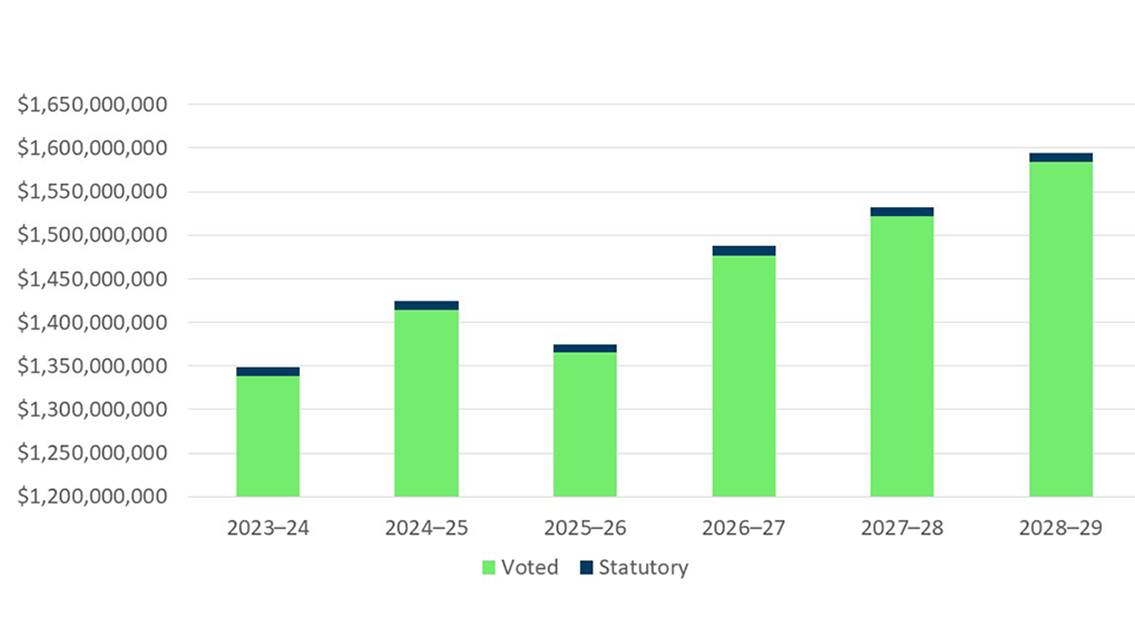
Graph 1: Approved funding (statutory and voted) over a six-year period
Graph 1 summarizes the department's approved voted and statutory funding from 2023-24 to 2028-29.
Text version of graph 1
| Fiscal year | Total | Voted | Statutory |
|---|---|---|---|
| 2023-24 | $1,348,456,197 | $1,338,273,413 | $10,182,784 |
| 2024-25 | $1,424,372,235 | $1,414,476,205 | $9,896,030 |
| 2025-26 | $1,374,539,221 | $1,365,260,287 | $9,278,934 |
| 2026-27 | $1,487,399,731 | $1,476,993,673 | $10,406,058 |
| 2027-28 | $1,531,945,469 | $1,521,932,707 | $10,012,762 |
| 2028-29 | $1,594,417,919 | $1,584,384,313 | $10,033,606 |
-
Analysis of statutory and voted funding over a six-year period
The net increase of $75.9M between 2023-24 and 2024-25 was mainly due to funding received from Budget 2024 (including increased support to core research grants, support for graduate students and postdoctoral researchers, and endowment to the Gairdner Foundation) and the allocation of funding for time-limited Tri-Agency programs.
Between 2025-26 and 2026-27 there is a net increase of $112.9M. This net increase is largely explained by:
- A decrease of $4.0M for the sunsetting of Diabetes Prevention, Research, and Surveillance (Budget 2021).
- An increase of $115.4M for the following programs:
- $50.2M for International Research Talent Recruitment (Budget 2025);
- $40.7M to support core research grants (Budget 2024);
- $16.7M for the Canada Research Training Award Suite (Budget 2024); and
- $7.8M for cannabis research.
Since its inception in 2000, and while continuing to deliver an increasing number of funding programs and initiatives, CIHR’s operating budget has remained at 6% of its total budget.
For further information on CIHR’s departmental appropriations, consult the 2026-27 Main Estimates.
Future-oriented condensed statement of operations
The future-oriented condensed statement of operations provides an overview CIHR’s operations for 2025-26 to 2026-27.
Table 9: Future-oriented condensed statement of operations for the year ended March 31, 2027 (dollars)
Table 9 summarizes the expenses and revenues which net to the cost of operations before government funding and transfers for 2025-26 to 2026-27. The forecast and planned amounts in this statement of operations were prepared on an accrual basis. The forecast and planned amounts presented in other sections of the Departmental Plan were prepared on an expenditure basis. Amounts may therefore differ.
| Financial information | 2025-26 Forecast results | 2026-27 Planned results | Difference (forecasted results minus planned) |
|---|---|---|---|
| Total expenses | 1,386,903,744 | 1,495,974,751 | 109,071,007 |
| Total revenues | 5,901,534 | 5,204,984 | (696,550) |
| Net cost of operations before government funding and transfers | 1,381,002,210 | 1,490,769,767 | 109,767,557 |
-
Analysis of forecasted and planned results
Total expenses are primarily comprised of grant and award payments for health research and training, estimated at approximately $1,293.4M in 2025-26 and $1,399.9M in 2026-27, representing a year-over-year increase of about 8.2%. This increase of $106.5M is largely attributable to new grants funding announced in Budget 2024 and Budget 2025.
Total revenues consist of funds received from external partners to support health research and training. Revenues are expected to decline slightly in 2026-27, reflecting an anticipated decrease in funding from external partners.
A more detailed Future-Oriented Statement of Operations and associated Notes for 2026-27, including a reconciliation of the net cost of operations with the requested authorities, is available on CIHR’s website.
Human resources
This section presents an overview of the department’s actual and planned human resources from 2023-24 to 2028-29.
Table 10: Actual human resources for core responsibilities and internal services
Table 10 shows a summary of human resources, in full-time equivalents, for CIHR’s core responsibilities and for its internal services for the previous three fiscal years. Human resources for the 2025-26 fiscal year are forecasted based on year to date.
| Core responsibility and internal services | 2023-24 Actual full-time equivalents | 2024-25 Actual full-time equivalents | 2025-26 Forecasted full-time equivalents |
|---|---|---|---|
| Funding Health Research and Training | 327 | 298 | 262 |
| Subtotal | 327 | 298 | 262 |
| Internal services | 289 | 264 | 238 |
| Total | 616 | 562 | 500 |
-
Analysis of human resources over the last three years
The reduction in full-time equivalents from 2023-24 to 2024-25 was due to the wind-down of time-limited initiatives and associated temporary positions. The temporary decrease from 2024-25 to 2025-26 reflects conservative staffing decisions taken during the CIHR’s organizational review.
Table 11: Human resources planning summary for core responsibilities and internal services
Table 11 shows information on human resources, in full-time equivalents, for each of CIHR’s core responsibilities and for its internal services planned for the next three years.
| Core responsibility and internal services | 2026-27 Planned full-time equivalents | 2027-28 Planned full-time equivalents | 2028-29 Planned full-time equivalents |
|---|---|---|---|
| Funding Health Research and Training | 289 | 263 | 264 |
| Subtotal | 289 | 263 | 264 |
| Internal services | 245 | 245 | 242 |
| Total | 534 | 508 | 506 |
-
Analysis of human resources for the next three years
Full-time equivalents are expected to decline from 2026-27 to 2027-28 as time-limited initiatives and associated temporary positions are phased out and are expected to remain relatively stable between 2027-28 and 2028-29.
Supplementary information tables
The following supplementary information tables are available on CIHR’s website:
Information on CIHR’s departmental sustainable development strategy can be found on CIHR’s website.
Federal tax expenditures
CIHR’s Departmental Plan does not include information on tax expenditures.
The tax system can be used to achieve public policy objectives through the application of special measures such as low tax rates, exemptions, deductions, deferrals and credits. The Department of Finance Canada publishes cost estimates and projections for these measures each year in the Report on Federal Tax Expenditures.
This report also provides detailed background information on tax expenditures, including descriptions, objectives, historical information and references to related federal spending programs as well as evaluations and GBA Plus of tax expenditures.
Corporate information
-
Departmental profile
Appropriate minister:
The Honourable Marjorie Michel, P.C., M.P., Minister of Health
Institutional head:
Dr. Paul Hébert, President
Ministerial portfolio:
Health
Enabling instrument:
Canadian Institutes of Health Research Act (S.C. 2000, c. 6)
Year of incorporation / commencement:
2000
-
Departmental contact information
Mailing address:
Canadian Institutes of Health Research
234 Laurier Ave West
Address Locator 4809A
Ottawa, Ontario K1A 0K9Telephone:
613-954-1968
TTY:
1-888-603-4178
Email:
support-soutien@cihr-irsc.gc.ca
Website:
Definitions
List of terms
- appropriation (crédit)
- Any authority of Parliament to pay money out of the Consolidated Revenue Fund.
- budgetary expenditures (dépenses budgétaires)
- Operating and capital expenditures; transfer payments to other levels of government, departments or individuals; and payments to Crown corporations.
- core responsibility (responsabilité essentielle)
- An enduring function or role performed by a department. The intentions of the department with respect to a core responsibility are reflected in one or more related departmental results that the department seeks to contribute to or influence.
- Departmental Plan (plan ministériel)
- A report on the plans and expected performance of an appropriated department over a 3year period. Departmental Plans are usually tabled in Parliament each spring.
- departmental result (résultat ministériel)
- A consequence or outcome that a department seeks to achieve. A departmental result is often outside departments’ immediate control, but it should be influenced by program-level outcomes.
- Departmental result indicator (indicateur de résultat ministériel)
- A quantitative measure of progress on a departmental result.
- departmental results framework (cadre ministériel des résultats)
- A framework that connects the department’s core responsibilities to its departmental results and departmental result indicators.
- Departmental Results Report (rapport sur les résultats ministériels)
- A report on a department’s actual accomplishments against the plans, priorities and expected results set out in the corresponding Departmental Plan.
- full-time equivalent (équivalent temps plein)
- A measure of the extent to which an employee represents a full person-year charge against a departmental budget. For a particular position, the full-time equivalent figure is the ratio of number of hours the person actually works divided by the standard number of hours set out in the person’s collective agreement.
- gender-based analysis plus (GBA Plus) (analyse comparative entre les sexes plus [ACS Plus])
-
Is an analytical tool used to support the development of responsive and inclusive policies, programs, and other initiatives. GBA Plus is a process for understanding who is impacted by the issue or opportunity being addressed by the initiative; identifying how the initiative could be tailored to meet diverse needs of the people most impacted; and anticipating and mitigating any barriers to accessing or benefitting from the initiative. GBA Plus is an intersectional analysis that goes beyond biological (sex) and socio-cultural (gender) differences to consider other factors, such as age, disability, education, ethnicity, economic status, geography (including rurality), language, race, religion, and sexual orientation.
Using GBA Plus involves taking a gender- and diversity-sensitive approach to our work. Considering all intersecting identity factors as part of GBA Plus, not only sex and gender, is a Government of Canada commitment.
- government priorities (priorités pangouvernementales)
- For the purpose of the 2026-27 Departmental Plan, government priorities are the high-level themes outlining the government’s agenda in the 2025 Speech from the Throne.
- horizontal initiative (initiative horizontale)
- An initiative where two or more federal departments are given funding to pursue a shared outcome, often linked to a government priority.
- Indigenous business (entreprise autochtones)
- Requirements for verifying Indigenous businesses for the purposes of the departmental result report are available through the Indigenous Services Canada Mandatory minimum 5% Indigenous procurement target website.
- nonbudgetary expenditures (dépenses non budgétaires)
- Non-budgetary authorities that comprise assets and liabilities transactions for loans, investments and advances, or specified purpose accounts, that have been established under specific statutes or under non-statutory authorities in the Estimates and elsewhere. Non-budgetary transactions are those expenditures and receipts related to the government's financial claims on, and obligations to, outside parties. These consist of transactions in loans, investments and advances; in cash and accounts receivable; in public money received or collected for specified purposes; and in all other assets and liabilities. Other assets and liabilities, not specifically defined in G to P authority codes are to be recorded to an R authority code, which is the residual authority code for all other assets and liabilities.
- performance (rendement)
- What a department did with its resources to achieve its results, how well those results compare to what the department intended to achieve, and how well lessons learned have been identified.
- performance indicator (indicateur de rendement)
- A qualitative or quantitative means of measuring an output or outcome, with the intention of gauging the performance of a department, program, policy or initiative respecting expected results.
- plan (plan)
- The articulation of strategic choices, which provides information on how a department intends to achieve its priorities and associated results. Generally, a plan will explain the logic behind the strategies chosen and tend to focus on actions that lead to the expected result.
- planned spending (dépenses prévues)
-
For Departmental Plans and Departmental Results Reports, planned spending refers to those amounts presented in Main Estimates.
A department is expected to be aware of the authorities that it has sought and received. The determination of planned spending is a departmental responsibility, and departments must be able to defend the expenditure and accrual numbers presented in their Departmental Plans and Departmental Results Reports.
- program (programme)
- Individual or groups of services, activities or combinations thereof that are managed together within the department and focus on a specific set of outputs, outcomes or service levels
- program inventory (répertoire des programmes)
- Identifies all the department’s programs and describes how resources are organized to contribute to the department’s core responsibilities and results.
- result (résultat)
- A consequence attributed, in part, to a department, policy, program or initiative. Results are not within the control of a single department, policy, program or initiative; instead they are within the area of the department’s influence.
- statutory expenditures (dépenses législatives)
- Expenditures that Parliament has approved through legislation other than appropriation acts. The legislation sets out the purpose of the expenditures and the terms and conditions under which they may be made.
- target (cible)
- A measurable performance or success level that a department, program or initiative plans to achieve within a specified time period. Targets can be either quantitative or qualitative.
- voted expenditures (dépenses votées)
- Expenditures that Parliament approves annually through an appropriation act. The vote wording becomes the governing conditions under which these expenditures may be made.
- Date modified: