National Gathering of Graduate Students (NGGS) 2025: Empowering Indigenous Research and Collaboration

The National Gathering of Indigenous Graduate Students (NGGS) is an annual event that brings together Indigenous graduate students from across Canada who are conducting research on Indigenous health and well-being. The 2025 edition, held in Banff from October 27 to 30, was organized by the Indigenous Primary Health Care Policy and Research (IPHCPR) Network, Alberta’s Network Environments for Indigenous Health Research (NEIHR) hub.
This year’s gathering welcomed over 90 Indigenous Master’s and PhD students from across the country, who delivered 58 oral presentations and showcased 30 research posters. The conference also featured seasoned researchers and professionals, fostering engagement, knowledge mobilization, and transdisciplinary collaboration.
In her opening remarks, Dr. Chelsea Gabel, Scientific Director of the Canadian Institutes of Health Research (CIHR) Institute of Indigenous Peoples’ Health (IIPH), reflected on her own experience attending NGGS as a graduate student and emphasized its value for building lasting connections. Dr. Robert Henry, Chair of the NEIHR National Coordinating Centre, reinforced this sentiment, describing NGGS as “the premier space for NEIHRs” in their efforts to support Indigenous research.
Other academics and professionals who shared their expertise at the conference included:
- Dr. Lynden (Lindsay) Crowshoe, Nominated Principal Investigator of the IPHCPR Network and Blackfoot primary care physician and researcher
- Dr. Ester Tailfeathers, Assistant Dean of Indigenous Health and Associate Professor at the University of Calgary’s Cumming School of Medicine, and a family physician
- Dr. Adam Murry, Co-Principal Investigator of the IPHCPR Network and Associate Professor of Psychology at the University of Calgary
- Keynote presentation by Dr. Leroy Little Bear, Niitsitapi (Blackfoot) scholar, Professor Emeritus, and Vice-Provost of Indigenous Iniskim Relations at the University of Lethbridge
At the closing ceremony, Dr. Gabel and Dr. Henry presented Certificates of Excellence to four students chosen from numerous high-quality submitted abstracts. They were selected prior to NGGS for the strength of their research topic, study design, objectives, methodology, and the overall quality of their written abstract.
Winning Projects
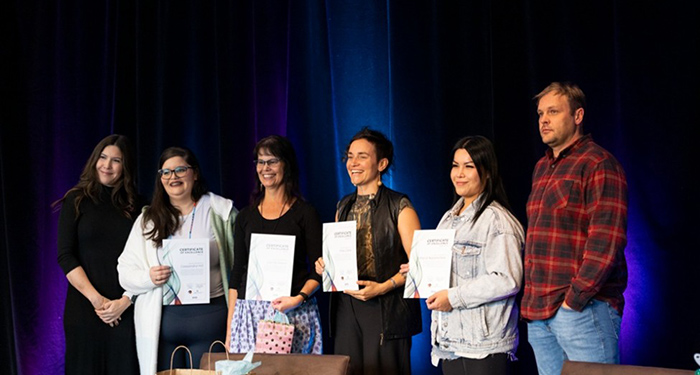
From left to right: Dr. Chelsea Gabel (Scientific Director, CIHR–Institute of Indigenous Peoples’ Health), Cassandra “Cassie” Hill, Laurie Sherry, Moe Clark, Sheila Naytowhow, and Dr. Robert Henry (Chair, NEIHR National Coordinating Centre).
The descriptions below are summaries of the original abstracts.
PhD award recipients:
Laurie Sherry, School of Social Work, McMaster University
Dibaajimotaadiwag (They Tell Stories): Indigenous Dispute Resolution & the Ethical Space of Engagement
This doctoral research examines the transformative benefits of Indigenous Child Welfare Dispute Resolution (ICWDR) circles while challenging colonial policies and practices that undermine Indigenous approaches to child well-being. It aims to mobilize Indigenous inquiry within Indigenous–Western relations to envision decolonial possibilities in service systems for Indigenous Peoples.
Cassandra (Cassie) Hill, Athabasca University
The Fire Inside the Screen: Indigenous Women, AI, and the Mental Health Impacts of Digital Learning after Trauma
This doctoral research explores the psychological impacts of asynchronous versus synchronous learning on Indigenous women who have experienced gender-based violence (GBV). It examines how technology intersects with trauma, particularly for Indigenous women disproportionately affected by GBV and systemic educational exclusion.
Master’s award recipients:
Sheila Naytowhow, University of Saskatchewan
See our experiences: An innovative phenomenological approach for analyzing the holistic wellness of Indigenous leaders
This research uses phenomenology and Indigenous wellness concepts to examine the health impacts experienced by First Nations Elected Officials (FNEOs), whose demanding roles involve advocating for change while navigating unjust systems.
Moe Clark, Concordia University
tastawayihk (2Spirit) Drumming: Resurgent Practices of Reclamation and Cultural Continuity
This project explores how drumming supports healing and self-determination for Two-Spirit people by reclaiming cultural practices suppressed under colonial laws and gendered violence. In response to this cultural erasure, the research seeks to reanimate the sacred relationship with the drum.
- Date modified: