Quarterly Financial Report for the quarter ended September 30, 2026
Table of contents
- Introduction
- Highlights of fiscal quarter and fiscal year-to-date results
- Risk and uncertainties
- Significant changes related to personnel, operations and programs
- Annex A - Statement of Authorities (unaudited)
- Annex B - Departmental budgetary expenditures by Standard Object (unaudited)
1. Introduction
This quarterly financial report has been prepared by management as required by section 65.1 of the Financial Administration Act and in the form and manner prescribed by the Treasury Board. This quarterly report should be read in conjunction with the Main Estimates and Supplementary Estimates. It has not been subject to an external audit or review, nor has it been subject to the approval of the Audit Committee.
1.1 Authority, mandate and programs
The Canadian Institutes of Health Research (CIHR) is the Government of Canada's health research funding agency. It was created in June 2000 by the Canadian Institutes of Health Research Act with a mandate “to excel, according to internationally accepted standards of scientific excellence, in the creation of new knowledge and its translation into improved health for Canadians, more effective health services and products and a strengthened Canadian health care system.”
CIHR invests in high-quality health research and health research personnel to help create and apply new knowledge that can improve health outcomes for Canadians, lead to innovative products and services that improve Canada's health care system and create high-quality employment and commercial opportunities.
Further details on CIHR’s mandate and program activities can be found in Part II of the Main Estimates and the Departmental Plan.
1.2 Basis of presentation
This quarterly report has been prepared using an expenditure basis of accounting. The accompanying Statement of Authorities includes CIHR’s spending authorities granted by Parliament, and those used by the organization consistent with the Main Estimates and Supplementary Estimates (as applicable). This report has been prepared using a special-purpose financial reporting framework designed to meet financial information needs with respect to the use of spending authorities.
The authority of Parliament is required before monies can be spent by the Government of Canada. Approvals are given in the form of annually approved limits through appropriation acts, or through legislation in the form of statutory spending authority for specific purposes.
CIHR uses the full accrual method of accounting to prepare and present its annual departmental financial statements that are part of the departmental results reporting process. However, the spending authorities voted by Parliament remain on an expenditure basis.
2. Highlights of fiscal quarter and fiscal year-to-date results
This section highlights the significant items that contributed to the change in resources available for the fiscal year, and the actual year-to-date expenditures compared with the previous fiscal year.
The following graph provides a comparison of budgetary authorities available for the full fiscal year and quarterly budgetary expenditures for the fiscal years 2026-27 and 2025-26.
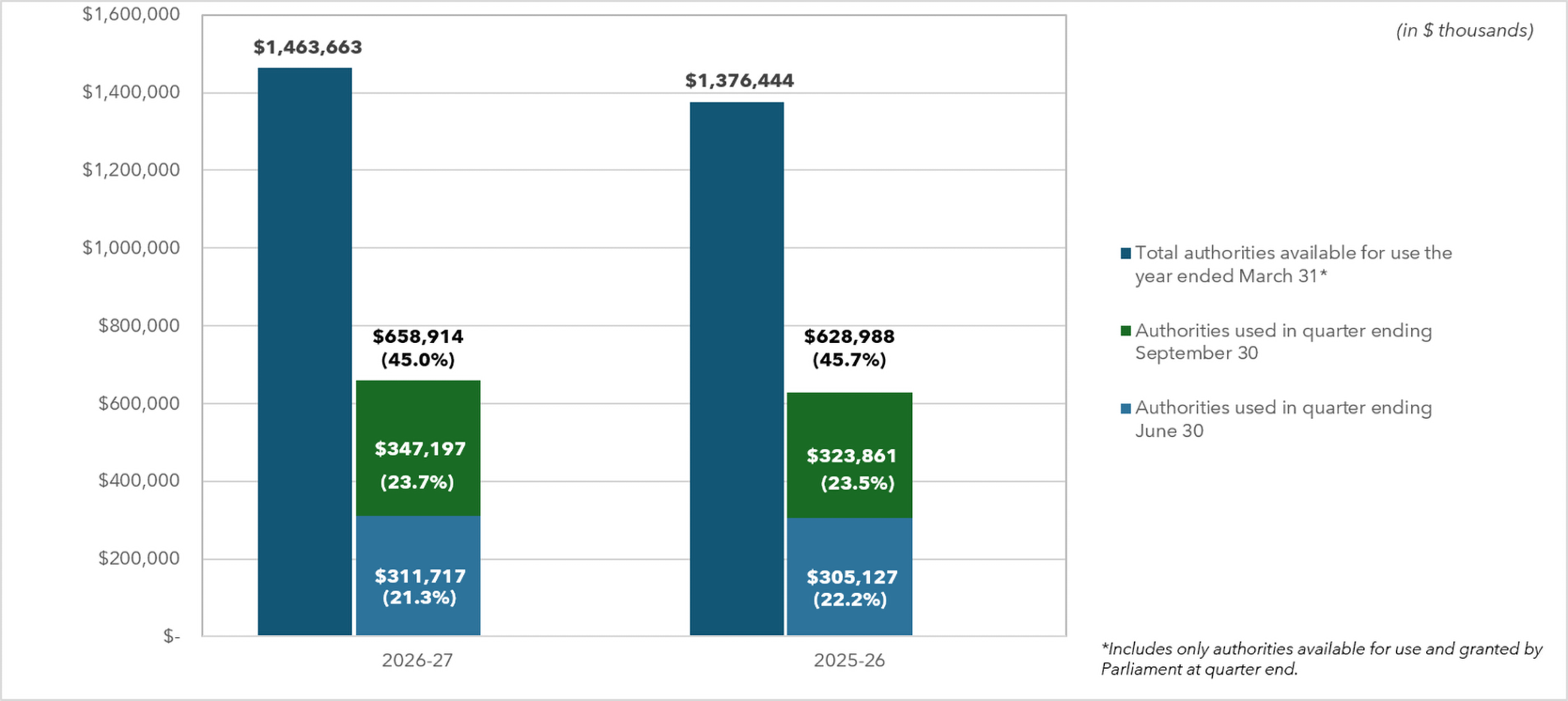
Long description
(in $ thousands)
| 2026-27 | 2025-26 | 2026-27 % | 2025-26 % | |
|---|---|---|---|---|
| Total authorities available for use the year ended March 31Footnote * | $1,463,663 | $1,376,444 | ||
| Authorities used as at June 30 | $311,717 | $305,127 | 21.3% | 22.2% |
| Authorities used as at September 30 | $347,197 | $323,861 | 23.7% | 23.5% |
| Authorities used to date | $658,914 | $628,988 | 45.0% | 45.7% |
2.1 Significant changes to budgetary authorities
Total budgetary authorities available for use increased by $87.2 million (6.3%) from the previous fiscal year.
Budgetary authorities available for use
(in $ thousands)
| 2026-27 | 2025-26 | $ change | % change | |
|---|---|---|---|---|
| Vote 1 - Operating Expenditures | 78,433 | 77,928 | 505 | 0.6% |
| Vote 5 - Grants | 1,374,824 | 1,288,833 | 85,991 | 6.7% |
| Statutory Authorities (employee benefits plan) |
10,406 | 9,683 | 723 | 7.5% |
| Total | 1,463,663 | 1,376,444 | 87,219 | 6.3% |
The following table provides a detailed explanation of changes to CIHR’s authorities by Vote.
| Changes to voted and statutory authorities (2026–27 compared with 2025-26) | Vote 1 Operating |
Vote 5 Grants |
Statutory AuthoritiesFootnote * |
Total |
|---|---|---|---|---|
| International Research Talent Recruitment | - | 50,153 | - | 50,153 |
| Increased support for core research grants | 104 | 40,613 | 12 | 40,729 |
| Canada Research Training Award Suite | 241 | 16,408 | 64 | 16,713 |
| Cannabis | 26 | 7,750 | (8) | 7,768 |
| Operating Budget Carry Forward | 1,906 | - | - | 1,906 |
| Youth Mental Health Fund | (164) | 1,932 | (33) | 1,735 |
| Indigenous Health Research Capacity | - | 1,250 | - | 1,250 |
| Canadian Genomics Strategy | 16 | 820 | 4 | 840 |
| EBP Adjustment | - | - | 705 | 705 |
| Black Scholarships & Fellows | 13 | 347 | 3 | 363 |
| Net transfers from other government departments for specific programs and initiatives | 13 | (19) | - | (6) |
| Various low-dollar adjustments and vote transfer | (41) | (82) | (2) | (125) |
| Net effect of CIHR’s participation in tri-agency programs in collaboration with the Natural Sciences and Engineering Research Council (NSERC) and the Social Sciences and Humanities Research Council (SSHRC) | - | (342) | - | (342) |
| Dementia and Brain Health in Aging | 20 | (830) | 7 | (803) |
| Long-Term Health Impacts of COVID-19 | 20 | (1,128) | 5 | (1,103) |
| National Strategy for Drugs for Rare Diseases | 20 | (1,500) | 5 | (1,475) |
| Diabetes Prevention, Research, Surveillance | (152) | (3,790) | (39) | (3,981) |
| Graduate students and postdoctoral researchers | - | (12,411) | - | (12,411) |
| Comprehensive Expenditure Review | (1,518) | (25,590) | - | (27,108) |
| Total | 505 | 85,991 | 723 | 87,219 |
2.2 Significant changes to authorities used
The following table provides a comparison of cumulative spending by vote for the current and previous fiscal years.
Q2 expenditures
(in $ thousands)
| 2026-27 | 2025-26 | $ change | % change | |
|---|---|---|---|---|
| Vote 1 – Operating Expenditures | 18,296 | 17,018 | 1,278 | 7.5% |
| Vote 5 – Grants | 326,299 | 304,422 | 21,877 | 7.2% |
| Statutory Authorities (employee benefits plan) |
2,602 | 2,421 | 181 | 7.5% |
| Total | 347,197 | 323,861 | 23,336 | 7.2% |
Through the second quarter of 2026–27, CIHR continued to implement the various reduction measures associated with the Government of Canada’s Comprehensive Expenditure Review. These measures, which impact both Operating and Grants votes, are being phased in over time, requiring the Agency to adjust planned expenditures and activities to achieve the identified reductions while continuing to support delivery of its mandate.
Vote 1 – Operating Expenditures
Total expenditures in the second quarter increased by $1.3 million (7.5%). The following table provides a comparison by standard object and a brief explanation for material variances.
Q2 expenditures
(in $ thousands)
| Standard object | 2026-27 | 2025-26 | $ change | Variance analysis |
|---|---|---|---|---|
| Personnel | 16,587 | 15,363 | 1,224 | Increase is primarily attributable to one-time expenditures associated with workforce adjustment actions implemented during the period. |
| Transportation and communications | 214 | 179 | 35 | Not material. |
| Information | 74 | 88 | (14) | Not material. |
| Professional and special services | 735 | 726 | 9 | Not material. |
| Rentals | 630 | 517 | 113 | Increase due to a delay in billing from another government department for annual costs of shared information systems. |
| Repair and maintenance | 5 | 32 | (27) | Not material. |
| Utilities, materials and supplies | 6 | 10 | (4) | Not material. |
| Acquisition of machinery and equipment | 5 | 39 | (34) | Not material. |
| Other subsidies and payments | 40 | 64 | (24) | Lower expenditures related to legal costs. |
| Total | 18,296 | 17,018 | 1,278 | |
| Percentage of authorities used | 23.3% | 21.8% |
Vote 5 – Grants
Grant authorities used through the second quarter of 2026-27 increased by $21.9 million (7.2%) compared to the prior fiscal year. The percentage of grant authorities used to date is consistent with the prior year (45.2% and 45.8% respectively), as grants are typically paid out in monthly installments throughout the year.
Overall spending as of September 30, 2026, is consistent with management expectations.
Statutory Authorities
Actual spending for statutory authorities in the second quarter of 2026-27 is 50.0% of the total available authorities for use for the year, which is consistent with CIHR management expectations given that this expenditure is distributed equally throughout the fiscal year.
3. Risks and uncertainties
CIHR has established a formal risk management framework through its Organizational Risk Profile (ORP) and comprehensive Risk Register, aligned with the Treasury Board Secretariat’s Risk and Compliance Process. The ORP provides a strategic view of CIHR’s key enterprise risks and supports Governing Council oversight, while the Risk Register documents corporate and operational risks, including mitigation strategies, risk assessments, and assigned Risk Owners.
The recent organizational risk review exercise identified the following key enterprise organizational risks. The descriptions below summarize the nature of each risk and its potential implications for CIHR.
- Mandate Impact & Research Funding - CIHR may be unable to maximize the impact of finite research funding while responding to changing needs, priorities and demand.
- Transformation & Execution Capacity - The scale and pace of transformation may exceed CIHR’s capacity to execute while sustaining core delivery.
- Digital, Data & Technology Sustainability - Legacy technology, technical debt, fragmented data and modernization complexity may constrain delivery, innovation and resilience.
- People, Culture & Organizational Resilience - Capacity, capability, change fatigue, trust and specialized-resource dependencies may impair CIHR’s ability to deliver and adapt.
- Stewardship, Governance & Institutional Effectiveness - Weak prioritization, governance ambiguity or resource-management constraints may reduce the quality and speed of enterprise decisions.
- Trust & Confidence in CIHR - Failures in fairness, integrity, reliability, transparency or impact may weaken confidence among researchers, partners, government and Canadians.
The ORP is presented annually to Governing Council, and the Risk Register is reviewed quarterly by Risk Owners to monitor risk status, mitigation progress, and emerging issues. These tools support effective risk identification, mitigation, monitoring, and reporting, strengthening accountability and informed decision-making across CIHR.
4. Significant changes related to personnel, operations and programs
4.1 Personnel
On June 16, 2026, CIHR announced the appointment of Chantal Marin-Comeau as the new Vice-President, Corporate Services and Transformation, starting July 2, 2026.
On September 28, 2026, CIHR announced that Crystal Lennie has been appointed to CIHR’s Governing Council for a three-year term.
4.2 Operations
CIHR continues to implement cost-reduction measures to address the 2% Comprehensive Expenditure Review (CER) reduction to its reference levels across operating and grant funding, while maintaining the effective delivery of its programs and operational commitments.
In parallel, CIHR is advancing its Resource Alignment Review (RAR) to align operating resources with its restructured organization, current priorities and evolving needs. The results of the exercise are expected to inform future-year resource allocations, with initial draft results anticipated by the end of the fiscal year.
4.3 Programs
No significant changes to note.
Approval by Senior Officials
Approved by:
[original signed by]
Paul C. Hébert, MD, MHSc, FRCPC, FCAHS
President
[original signed by]
Jimmy Fecteau, MBA, CPA
Chief Financial Officer
Ottawa, Canada
November 27, 2026
Annex A - Statement of Authorities (unaudited)
For the quarter ended September 30, 2026
2026-27
(in thousands of dollars)
| Total available for use for the year ending March 31, 2027Footnote * | Used during the quarter ended September 30, 2026 | Year to date used at quarter-end | |
|---|---|---|---|
| Vote 1 – Operating expenditures | 78,433 | 18,296 | 32,277 |
| Vote 5 - Grants | 1,374,824 | 326,299 | 621,433 |
| Contributions to employee benefit plans (Budgetary statutory authorities) | 10,406 | 2,602 | 5,204 |
| Total budgetary authorities | 1,463,663 | 347,197 | 658,914 |
|
|||
2025-26
(in thousands of dollars)
| Total available for use for the year ending March 31, 2026Footnote * | Used during the quarter ended September 30, 2025 | Year to date used at quarter-end | |
|---|---|---|---|
| Vote 1 – Operating expenditures | 77,928 | 17,018 | 34,046 |
| Vote 5 - Grants | 1,288,833 | 304,422 | 590,101 |
| Contributions to employee benefit plans (Budgetary statutory authorities) | 9,683 | 2,421 | 4,841 |
| Total budgetary authorities | 1,376,444 | 323,861 | 628,988 |
|
|||
Annex B - Departmental budgetary expenditures by Standard Object (unaudited)
For the quarter ended September 30, 2026
2026-27
(in thousands of dollars)
| Expenditures | Planned expenditures for the year ending March 31, 2027Footnote * | Expended during the quarter ended September 30, 2026 | Year to date used at quarter-end |
|---|---|---|---|
| Personnel | 74,343 | 19,189 | 34,135 |
| Transportation and communications | 1,765 | 214 | 392 |
| Information | 829 | 74 | 172 |
| Professional and special services | 6,361 | 735 | 1,287 |
| Rentals | 4,403 | 630 | 1,425 |
| Repairs and maintenance | 744 | 5 | 15 |
| Utilities, materials and supplies | 47 | 6 | 8 |
| Acquisition of machinery and equipment | 343 | 5 | 6 |
| Transfer payments | 1,374,824 | 326,299 | 621,433 |
| Other subsidies and payments | 4 | 40 | 41 |
| Total budgetary expenditures | 1,463,663 | 347,197 | 658,914 |
|
|||
2025-26
(in thousands of dollars)
| Expenditures | Planned expenditures for the year ending March 31, 2026Footnote * | Expended during the quarter ended September 30, 2025 | Year to date used at quarter-end |
|---|---|---|---|
| Personnel | 74,042 | 17,784 | 35,228 |
| Transportation and communications | 878 | 179 | 270 |
| Information | 779 | 88 | 307 |
| Professional and special services | 5,512 | 726 | 1,243 |
| Rentals | 4,834 | 517 | 1,683 |
| Repairs and maintenance | 747 | 32 | 34 |
| Utilities, materials and supplies | 48 | 10 | 12 |
| Acquisition of machinery and equipment | 513 | 39 | 46 |
| Transfer payments | 1,288,833 | 304,422 | 590,101 |
| Other subsidies and payments | 258 | 64 | 64 |
| Total budgetary expenditures | 1,376,444 | 323,861 | 628,988 |
|
|||
- Date modified: