Canadian Institutes of Health Research Annual Report 2025–26
Content
- Chair's Message
- Providing Stewardship and Accountability
- Financial Statement Discussion and Analysis
- Financial Statements
Message from the Chair of CIHR Governing Council

Dr. Marie-Josée Hébert
Chair, CIHR Governing Council
As Chair of the Governing Council, it is my privilege to present the 2025-26 Annual Report of the Canadian Institutes of Health Research (CIHR), the Government of Canada’s health research investment agency.
This year’s report is framed by a forward-looking theme of Collaboration for Impact, reflecting CIHR’s commitment to advancing health research through, shared responsibility, partnerships, and collective leadership across Canada’s research ecosystem. Guided by its Strategic Plan, and responding to evolving opportunities and challenges, CIHR continues to pursue research excellence and drive impact, while also recognizing that a diversity of perspectives within the research enterprise strengthens innovation, impact, and health outcomes for all Canadians.
In 2025-26, under the continued leadership of Dr. Paul Hébert, CIHR also marked important organizational milestones, including its 25th anniversary and significant steps to strengthen its structure and governance. These moments provided an opportunity not only to reflect on a quarter century of leadership in building a more inclusive, interdisciplinary, and results-driven health research system, but also to position the organization for continued impact in a rapidly evolving health and science landscape.
At the heart of CIHR’s work is an enduring commitment to generate and mobilize knowledge that meaningfully improves health, strengthens communities, and advances national prosperity. By aligning our efforts with the most pressing challenges facing people and communities, CIHR aims to contribute to a world-leading health and life sciences ecosystem, one that delivers better outcomes for Canadians and drives long-term social and economic vitality.
Leadership through partnerships, listening, and shared responsibility
As highlighted in the Report of the Advisory Panel on the Federal Research Support System, stronger coordination and collaboration are critical to reducing fragmentation and enabling a more coherent, aligned, and impactful research ecosystem in Canada.
CIHR as Convener for Collaboration
Over the past year, CIHR has focused on being a partner of choice. We have been able to advance several impactful initiatives including through engagement and partnership. Canada advanced key national health research priorities, such as the Canadian Genomics Strategy and mental health and substance use, through enhanced collaboration across the research and health systems landscape. In this context, CIHR continues to serve as a national convener, working closely with its tri-agency partners at the Social Sciences and Humanities Research Council (SSHRC) and the Natural Sciences and Engineering Research Council (NSERC), to align stakeholders, strengthen research capacity, and advance shared missions and priorities for Canadians. This role extends across government and the broader research ecosystem, with partnerships with Health Canada advancing priorities in health data, clinical trials, and primary care, collaboration with the Public Health Agency of Canada strengthening public health surveillance and pandemic readiness, and work with Innovation, Science and Economic Development Canada supporting progress in innovation, commercialization, and translational biology.
We are currently at an inflection point in health and life sciences research with the convergence of a biological revolution and growth of artificial intelligence (AI). As a result of technological advances, scientific processes that once took a decade now happen in days or weeks. AI, health data, and precision medicine are also converging to create possibilities that we could only imagine even a few years ago. In strategic partnership with our co-leads at the Canadian Institute for Health Information, CIHR is building on this opportunity by working with other federal departments and agencies and colleagues across the ecosystem to address the fragmentation of health data and unlock its potential as a strategic national asset. By convening partners across health, research, data, infrastructure, and patient communities, CIHR is helping to develop an implementation-ready roadmap for a connected, secure, and trusted health and life sciences data ecosystem. The roadmap will provide clear priorities and actions to guide coordinated investments and implementation and positioning Canada as a global leader in health data and life sciences.
Over the past year, CIHR also strengthened its efforts at the intersection of health research, innovation and commercialization by engaging stakeholders to identify systemic barriers and enhance coordination across government and stakeholders. Through its leadership in the Canada Research Coordinating Committee (CRCC), CIHR contributed to broader system alignment and supporting more integrated pathways from discovery to real-world application. Building on this work, CIHR increased its focus on supporting the full continuum of innovation, from early-stage research to the advancement of products and therapeutics, working closely with Governing Council and tri-agency partners to develop a more strategic and cohesive approach to commercialization across the federal research ecosystem to drive innovation and impact for Canadians.
Tri-agency Partnerships to Advance Research Priorities
CIHR and its tri-agency partners continue to strengthen Canada’s research ecosystem through coordinated investments that build talent, attract global expertise, and advance shared national priorities. CIHR’s continued collaboration with its tri-agency partners (NSERC and SSHRC) has been central to advancing these national research priorities. Through Budget 2025 investments, the launch of IMPACT+ marked a significant step in attracting world-class research leaders to Canadian institutions. The program aims to address pressing global and domestic challenges, strengthen Canada’s contribution to international research and innovation, and generate lasting social and economic benefits. Meanwhile, through Budget 2024 commitments, Canada’s funding agencies are expanding investments for domestic researchers, providing enhanced support for trainees by increasing both the value and number of scholarships and fellowships.
Advancing Indigenous Research Leadership and Self-Determination
Through collaborative action, Canada’s research funding agencies are helping to create the conditions for Indigenous communities to lead and shape research that reflects their priorities and knowledge systems. Tri-agency coordination advanced Indigenous leadership and self-determination in research through targeted investments that strengthen capacity, networks, and knowledge systems. This includes support for Indigenous-led connection grants that enable First Nations and Métis communities to convene, build research capacity, and mobilize knowledge, as well as network grants that foster holistic, Indigenous-led research collaborations across disciplines. Complementing these efforts, ongoing investments into the Inuit Research Network are strengthening research governance, partnerships, and knowledge mobilization across Inuit Nunangat. Collectively, these initiatives are driving more inclusive, distinctions-based research ecosystems that centre Indigenous knowledge systems and leadership, with lasting impact across Canada’s research enterprise.
Federal Priorities and Partnerships
Aligned with broader federal priorities, CIHR supported a range of targeted research initiatives addressing urgent and emerging health challenges, such as dementia, wildfires, primary care, cancer prevention, youth mental health, genomics, and sexually transmitted and blood-borne infections.
National Dementia Strategy
In 2025–26, CIHR and partners invested $45 million over five years to advance dementia and healthy brain aging research, reinforcing Canada’s leadership and supporting a coordinated approach spanning research, training, and knowledge mobilization. This includes funding the next phase of the Canadian Consortium on Neurodegeneration in Aging to drive multidisciplinary research on prevention, diagnosis, treatment, care, and equity; supporting a national training platform to develop the next generation of brain health leaders; and advancing a knowledge mobilization hub to translate evidence into practical tools for health systems and communities. These joint efforts strengthen Canada’s dementia research capacity, accelerate the translation of evidence into policy and practice, and support implementation of the national dementia strategy, including a strong focus on collaboration, equity, and Indigenous health research.
Wildfires
CIHR also invested $1.5 million over one and a half years to support a rapid response research initiative examining the impacts of wildfires and related evacuations on Indigenous communities, demonstrating its capacity to mobilize timely, targeted funding in response to emerging public health challenges. Delivered through the Indigenous-led Network Environments for Indigenous Health Research (NEIHR), this initiative brings together researchers and First Nations and Métis partners to co-develop evidence on the health, social, and cultural effects of climate-related emergencies. The research will inform more effective emergency management approaches, trauma-informed supports, and policy responses, while advancing rapid research methods to better prepare for future crises. This investment underscores CIHR’s commitment to Indigenous health research, community partnership, and addressing the disproportionate impacts of climate change on First Nations, Inuit, and Métis Peoples.
Primary Care
In partnership with Healthcare Excellence Canada, CIHR invested $3 million for one year to advance practical, evidence-informed improvements in primary care. This funding will support work with the Canadian Primary Care Research Consortium (CPCRC), a national network that works to strengthen primary care, and primary care delivery teams across Canada participating in Care Forward, a pan-Canadian movement that brings changemakers together to share knowledge and apply proven approaches to improve care. This investment reflects CIHR’s recognition of primary care as the foundation of a high-performing health system, and its commitment to support research that helps close gaps in access. Through collaboration with Healthcare Excellence Canada and leveraging the leadership of the CPCRC, this work will be grounded in strong evidence and shaped by the diverse needs of communities across Canada and reinforces CIHR’s broader commitment to strengthening health systems through research.
Cancer Prevention
In 2025–26, CIHR, in partnership with national and international collaborators, invested over
$41 million over five years in cutting-edge cancer prevention research. This is the largest CIHR-led investment in cancer prevention research to date, supporting the development and dissemination of innovative approaches to reduce cancer risk and enhance early detection for some of the most common cancers in Canada and globally. Aligned with CIHR’s commitment to research, these efforts aim to advance understanding of cancer development, strengthen prevention strategies, and translate research evidence into improved health outcomes, policy, and practice.
Youth Mental Health
CIHR has invested an additional $30 million over four years in the Integrated Youth Services Network of Networks (IYS-Net) initiative to further strengthen and expand this innovative model of care across Canada for youth mental health and substance use, with a focus on advancing provincial and territorial data, research, and infrastructure. This significant, long-term commitment reflects CIHR’s leadership in building and scaling learning health systems where data, research, and practice are continuously integrated to accelerate improvement. This allows for ongoing learning and collaboration among youth, families, and practitioners to refine services for Canadians across the country and Indigenous networks by equipping providers with the data and evidence needed to deliver high-quality services.
Canadian Genomics Strategy
As part of the Canadian Genomics Strategy, CIHR invested $10 million over six years in different projects to enhance data within the genomics ecosystem and increase Canada’s genomics-related talent. This includes investments in computational biology, health data sciences and bioinformatics, and will work to develop the next generation of genomics researchers, advance genomics as a key driver of innovation in health and strengthen the data environment related to genomics research.
HIV/AIDS and STBBIs
In support of the Government of Canada’s sexually transmitted and blood-borne infections (STBBI) Action Plan (2024-2030), CIHR invested $23 million this year in community-based research examining how stigma, racism, sexism, and other systemic and structural barriers affect people living with HIV/AIDS and other STBBIs. The initiative focuses on key populations disproportionately impacted by HIV and STBBI, to strengthen research capacity within these communities, advance community-led and culturally relevant approaches and improve health equity by supporting and enabling access to research that addresses the structural, social, behavioural, and biomedical determinants of health.
System Transformation for Strengthening Organizational Performance
From organizational modernization to celebrating 25 years of leadership and advancing knowledge mobilization, CIHR took important steps this year to strengthen its impact across the health research ecosystem.
Over the past year, significant steps were taken to advance a more coordinated and impact-oriented ecosystem. In 2025–26, CIHR implemented an organizational review to ensure its structure, leadership model, and resources are aligned with its mandate and strategic priorities, while responding to a period of fiscal restraint across the federal public service. The review focused on strengthening science, streamlining decision making, clarifying roles and responsibilities, and positioning the organization for long-term sustainability. Key outcomes included a redesigned executive leadership structure and targeted workforce adjustments implemented with an emphasis on fairness, transparency, and employee support. These measures have enhanced CIHR’s internal effectiveness, efficiency and organizational agility while protecting the delivery of core programs and support to the health research community.
CIHR also celebrated its 25th anniversary, a milestone recognizing a quarter century of leadership as Canada’s federal health research investment agency. In that time, CIHR has helped shape a more inclusive, interdisciplinary, and impact-driven health research ecosystem, supporting thousands of researchers and trainees across the country and strengthening evidence-based health care, policy, and innovation for Canadians. This anniversary provided an opportunity to reflect on CIHR’s origins, its research milestones, and its continued prioritization to generating knowledge and translating it into better health outcomes, a stronger health system, and shared prosperity for Canada.
Building on this foundation, CIHR’s Knowledge Mobilization Strategy and Action Plan, published this year, sets out a coordinated approach to promote the translation of high-quality health research into real-world benefits for people in Canada, including improved health outcomes, stronger health systems, and broader societal and economic impacts. It emphasizes collaboration with researchers, communities, Indigenous partners, policymakers, and industry to make knowledge more accessible, relevant and actionable, while addressing persistent gaps in how research is shared and used. The strategy focuses on four key areas: enhancing skills and capacity, transforming systems and incentives, investing in dedicated funding for knowledge mobilization activities, and continuously learning and improving, leading to research that is co-produced, inclusive, and effectively applied in practice and policy.
Conclusion
Taken together, these efforts demonstrate CIHR’s ongoing leadership in supporting an inclusive. dynamic, collaborative, and impactful health research system. I trust the information and data contained within this report will provide a clear understanding of CIHR’s activities and progress over the past year. I invite you to read the financial details that follow to gain further insights into the investments that facilitate support for advancing scientific knowledge and enhancing its integration to improve health and healthcare delivery. On behalf of the Governing Council, I extend my sincere appreciation to CIHR’s staff, researchers, partners, and communities for their dedication and contributions.
Sincerely,
Dr. Marie-Josée Hébert
Chair, CIHR Governing Council
Providing Stewardship and Accountability
CIHR Governing Council
CIHR reports to Parliament through the Minister of Health. Its Governing Council comprises a group of up to 16 members appointed by the Governor in Council, as well as the President of CIHR and the Deputy Minister of Health who are ex-officio non-voting members. Together they provide oversight and strategic direction for the organization and evaluate its overall performance.

Marie-Josée Hébert
Chair
Université de Montréal

Shanthi Johnson
Vice-Chair
University of Windsor

Paul Allison
Faculty of Dental Medicine & Oral Health Sciences
McGill University

Robert S. Bell
Former Deputy Minister, Ontario Ministry of Health and Long-Term Care

Mélanie Caron
National Institute of Excellence in Health and Social Services (INESSS)

Shalene Curtis-Micallef
Deputy Minister of Health
(Ex-officio, non-voting member)

Deborah DeLancey
Former Deputy Minister, Health and Social Services NWT

Annie Descôteaux
Université de Montréal

Christine Fahim
University of Toronto
John Hopkins University

Paul Hébert
President, CIHR
(Ex-officio, non-voting member)

Michal Juhas
Digital health expert and independent consultant: health policy, economics, and outcomes research

Cathy Kline
University of British Columbia

Bernard Le Foll
Centre for Addiction and Mental Health / Waypoint Centre for Mental Health Care University of Toronto

Siddika Mithani
Member, Research Board
Children's Hospital of Eastern Ontario & Hôpital Montfort

Caroline Tait
University of Calgary
Financial Statement Discussion and Analysis
Introduction
The following Financial Statement Discussion and Analysis (FSD&A) should be read in conjunction with the Canadian Institutes of Health Research (CIHR) financial statements and accompanying notes for the year ended March 31, 2026.
The responsibility for the integrity and objectivity of the FSD&A rests with the management of CIHR. The purpose of the FSD&A is to highlight information and provide explanations to enhance the user’s understanding of CIHR’s financial position and results of operations, while demonstrating CIHR’s accountability for its use of available resources. Additional information on CIHR’s performance is available in the CIHR Departmental Results Report, and information on its plans and priorities is available in the CIHR Department Plan.
Overview
The Canadian Institutes of Health Research was established in June 2000 under the Canadian Institutes of Health Research Act. It is listed in Schedule II to the Financial Administration Act as a departmental corporation. CIHR’s objective is to excel, according to international standards of scientific excellence, in the creation of new knowledge, and its translation into improved health, more effective health services and products, and a strengthened Canadian health care system.
CIHR’s budget is allocated through authorities approved by Parliament. CIHR has separate voted authorities for operating expenses and for grants/awards. Authorities provided to CIHR by Parliament do not parallel financial reporting according to Canadian public sector accounting standards, since authorities are primarily based on cash accounting principles. Consequently, items recognized in the Statement of Financial Position, the Statement of Operations and Departmental Net Financial Position, the Statement of Change in Departmental Net Debt, and the Statement of Cash Flows are not necessarily the same as those provided through authorities from Parliament. Note 3 of the Financial Statements provides users with a reconciliation between the two bases of reporting.
Highlights
CIHR’s financial results in 2025-26 are generally consistent with those of the preceding fiscal year.
Statement of Financial Position
| As at March 31 | 2026 | 2025 | % change |
|---|---|---|---|
| Total liabilities | $16.1 | $16.8 | (4.2%) |
| Total financial and non-financial assets | $16.3 | $15.9 | 2.6% |
Total liabilities decreased by $0.7 million, primarily reflecting reduced year-end staffing levels following an organizational review to strengthen alignment between CIHR’s structure, mandate, and strategic priorities.
Total financial and non-financial assets increased by $0.4 million, primarily due to a year-end receivable from central agencies, partially offset by a reduction in tangible capital assets driven by annual amortization.
Statement of Operations and Departmental Net Financial Position
| For the year ended March 31 | 2026 | 2025 | % change |
|---|---|---|---|
| Total expenses | $1,382.3 | $1,428.5 | (3.2%) |
| Net cost of operations before government funding and transfers | $1,376.3 | $1,424.7 | (3.4%) |
The decrease to total expenses (-3.2%) and in net cost of operations before government funding and transfers (-3.4%) is primarily attributable to lower Parliamentary authorities available to CIHR in 2025-26 compared to the prior year. Total authorities declined by $48.3 million in 2025-26 due to a decrease in authorities for Vote 5 – Grants ($44.5 million) and for Vote 1 – Operating Expenditures and statutory authorities ($3.8 million).
Variance and Trend Analysis
CIHR’s financial results for 2025–26 reflect moderate year-over-year decreases in both authorities and expenses. Fluctuations continue to be primarily driven by changes in funding levels.
Overview of authorities
CIHR’s total Parliamentary authorities available for use in 2025-26 were $1,377.3 million, representing a decrease of $48.3 million (-3.4%) compared to $1,425.6 million in 2024- 25. During the year, authorities increased modestly by $2.3 million relative to Main Estimates, primarily driven by:
| 2025-26 Main Estimates (in millions) | $1,375.0 |
|---|---|
| Operating budget carry-forward | 1.5 |
| Compensation adjustments from the Treasury Board Secretariat | (1.1) |
| Net transfers from other government departments | 1.9 |
| Total increase in Parliamentary authorities during the year | 2.3 |
| 2025-26 Year-end Parliamentary authorities | $1,377.3 |
Actual results
Total expenses
Total expenses in 2025-26 were $1,382.3 million, a decrease of $46.2 million (-3.2%) compared to 2024-25. This decrease closely aligns with the reduction in Parliamentary authorities and reflects CIHR’s continued ability to adjust spending in line with funding availability.
| For the year ended March 31 | 2026 | 2025 | % change |
|---|---|---|---|
| Grants and awards | $1,291.4 | $1,333.6 | (3.2%) |
| Operating expenses | $90.9 | $94.9 | (4.2%) |
As illustrated in the chart below, the ratio of operating expenses to total expenses was 6.6% in both 2025-26 and 2024-25, while grants and awards expenses made up 93.4%. This ratio has remained stable over time.
(in millions)
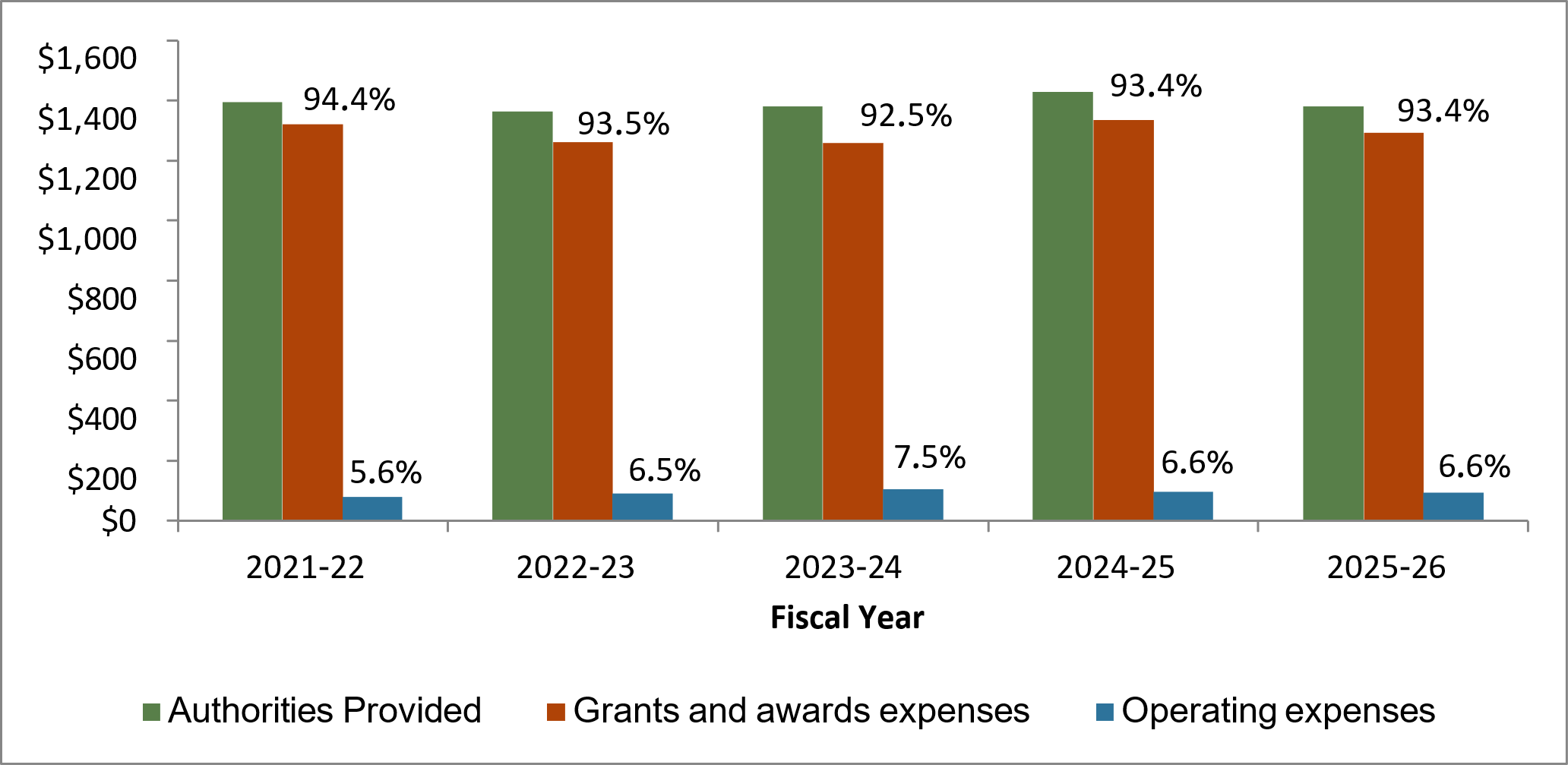
Grants and Awards Expenses - Long Description
| 2021–22 | 2022–23 | 2023–24 | 2024–25 | 2025–26 | |
|---|---|---|---|---|---|
| Authorities provided | $1,392.9 | $1,362.3 | $1,376.6 | $1,425.7 | $1,377.3 |
| Grants and awards expenses | $1,318.2 | $1,259.1 | $1,255.2 | $1,333.6 | $1,291.4 |
| Operating expenses | $78.5 | $87.5 | $101.6 | $94.9 | $90.9 |
| Percentage grants and awards | 94.4% | 93.5% | 92.5% | 93.4% | 93.4% |
| Percentage operating expenses | 5.6% | 6.5% | 7.5% | 6.6% | 6.6% |
Grants and awards expenses
Grants and awards expenses totaled $1,291.4 million, a decrease of $42.1 million (3.2%) relative to the prior year. This decline is consistent with the overall reduction in Parliamentary authorities available to CIHR.
Operating expenses
Salaries and employee benefits accounted for 85.6% of total operating expenses in 2025–26, compared to 88.7% in the prior year, reflecting the impact of workforce reductions and broader cost containment measures
(in millions)
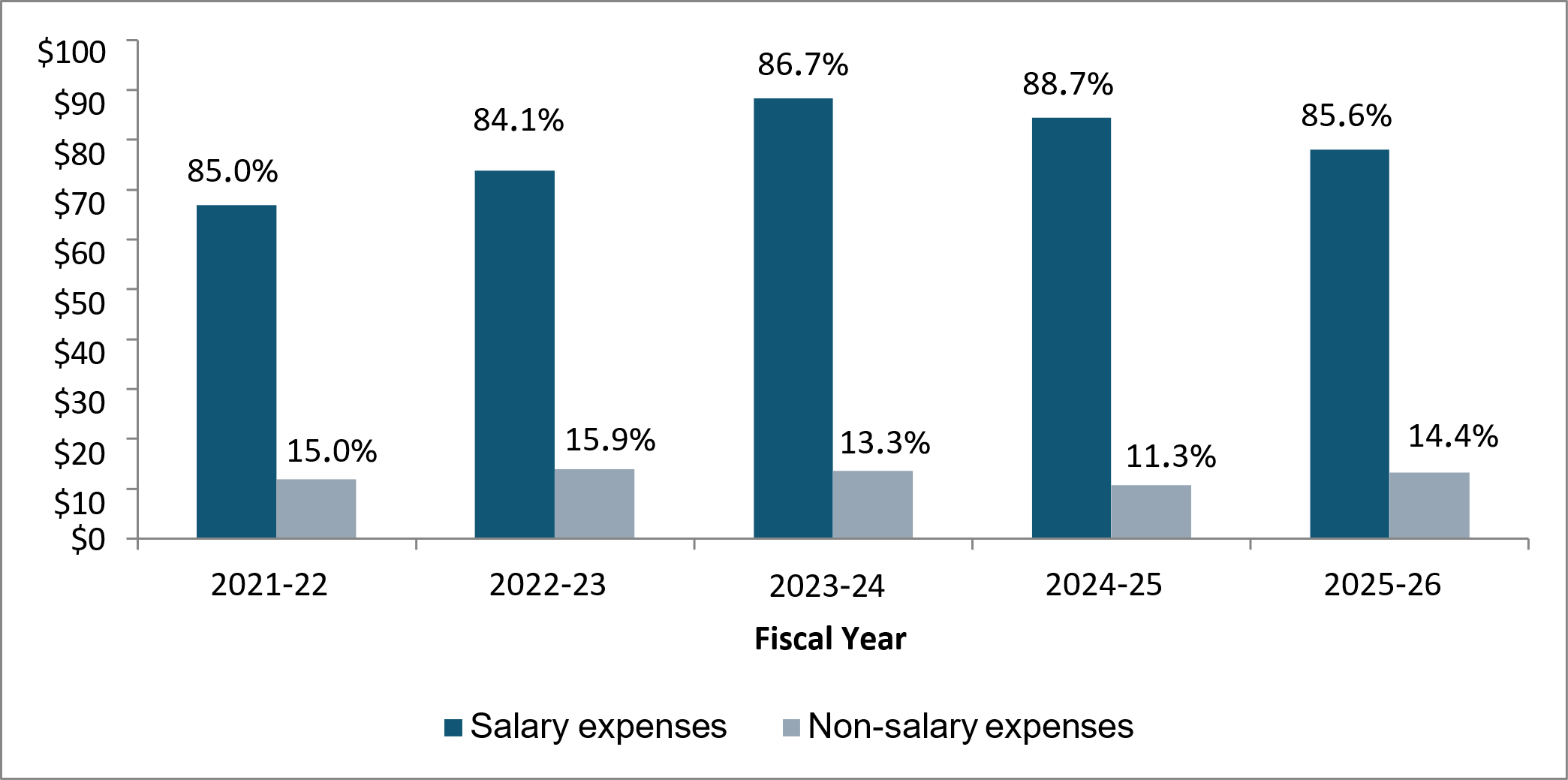
Operating Expenses - Long Description
| 2021–22 | 2022-23 | 2023-24 | 2024-25 | 2025–26 | |
|---|---|---|---|---|---|
| Salary expenses | $66.7 | $73.6 | $88.1 | $84.2 | $77.8 |
| Non-salary expenses | $11.8 | $13.9 | $13.5 | $10.7 | $13.1 |
| Total | $78.5 | $87.5 | $101.6 | $94.9 | $90.9 |
| Percentage salary expenses | 85.0% | 84.1% | 86.7% | 88.7% | 85.6% |
| Percentage non-salary expenses | 15.0% | 15.9% | 13.3% | 11.3% | 14.4% |
Total operating expenses were $90.9 million in 2025–26, a decrease of $4.1 million (-4.3%) compared to 2024–25. This variance was primarily driven by a $6.4 million (-7.6%) reduction in salaries and employee benefits, consistent with the impact of the corporate reorganization and associated staffing adjustments.
These decreases were partially offset by higher costs in other operating areas, including accommodation following CIHR’s transition to a new office space and incremental office relocation-related expenditures. Professional services and information technology-related expenditures also increased, primarily to support vacant positions in key functional areas during a period of ongoing cost containment, organizational restructuring, and constrained internal IT capacity.
Reductions in rental expenses of $0.7 million were also recorded, reflecting ongoing migration to cloud-based services and the associated reduction of legacy infrastructure.
Financial Outlook
While Budget 2026 is expected to be tabled this Fall, CIHR continues to be driven by Government of Canada priorities and is committed to maintaining its support to the research community.
CIHR is aligning its financial planning with the federal government's Comprehensive Expenditure Review to ensure government spending is responsible, cost-effective and delivers results for Canadians. For CIHR, the budget reductions total approximately $27 million per year.
Despite these reductions, CIHR's capacity to deliver on its mandate is reinforced by continued investments announced in Budget 2024 and Budget 2025. These investments include $541 million over five years ($229 million ongoing) to increase support to core research grants; $204 million over five years ($62 million ongoing) to increase the value and number of scholarships and fellowships and launch the new harmonized talent program called the Canada Research Training Awards Suite; and $417 million over 12 years for International Research Talent Recruitment.
CIHR is committed to implementing these changes thoughtfully to ensure continued support for Canada's health research community. Further details and specific impacts on CIHR's authorities are expected in upcoming government communications.
Financial Statements
Canadian Institutes of Health Research
Statement of Management Responsibility Including Internal Control over Financial Reporting
Responsibility for the integrity and objectivity of the accompanying financial statements for the year ended March 31, 2026, and all information contained in these financial statements rests with the management of the Canadian Institutes of Health Research (CIHR). These financial statements have been prepared by management using the Government of Canada’s accounting policies, which are based on Canadian public sector accounting standards.
Management is responsible for the integrity and objectivity of the information in these financial statements. Some of the information in the financial statements is based on management's best estimates and judgment, and gives due consideration to materiality. To fulfill its accounting and reporting responsibilities, management maintains a set of accounts that provides a centralized record of CIHR’s financial transactions. Financial information submitted in the preparation of the Public Accounts of Canada, and included in CIHR’s Departmental Results Report , is consistent with these financial statements.
Management is also responsible for maintaining an effective system of internal control over financial reporting (ICFR) designed to provide reasonable assurance that financial information is reliable, that assets are safeguarded and that transactions are properly authorized and recorded in accordance with the Financial Administration Act and other applicable legislation, regulations, authorities, and policies.
Management seeks to ensure the objectivity and integrity of data in its financial statements through careful selection, training and development of qualified staff; through organizational arrangements that provide appropriate divisions of responsibility; through communication programs aimed at ensuring that regulations, policies, standards and managerial authorities are understood throughout CIHR; and through conducting an annual risk-based assessment of the effectiveness of the system of ICFR.
The system of ICFR is designed to mitigate risks to a reasonable level based on an ongoing process to identify key risks, to assess effectiveness of associated key controls, and to make any necessary adjustments. A risk-based assessment of the system of ICFR for the year ended March 31, 2026 was completed in accordance with the Treasury Board Policy on Financial Management and the results and action plans are summarized in the annex.Footnote 1
The effectiveness and adequacy of CIHR’s system of internal control is reviewed by the work of internal audit staff, who conduct periodic audits of different areas of CIHR’s operations, and by CIHR’s Audit Committee, which oversees management’s responsibilities for maintaining adequate control systems and the quality of financial reporting, and which recommends the financial statements to the President of CIHR and its Governing Council.
The financial statements of CIHR have not been audited.
Approved by:
Paul C. Hébert, MD, MHSc, FRCPC, FCAHS
President
Jimmy Fecteau, MBA, CPA
Chief Financial Officer
Ottawa, Canada
July 28, 2026
Canadian Institutes of Health Research
Statement of Financial Position (unaudited)
As at March 31
(in thousands of dollars)
| 2026 | 2025 | |
|---|---|---|
| Liabilities | ||
| Accounts payable and accrued liabilities (note 4) | $8,401 | $8,422 |
| Vacation pay and compensatory leave | 4,405 | 4,818 |
| Deferred revenue (note 5) | 2,763 | 3,030 |
| Employee future benefits (note 6) | 574 | 502 |
| Total liabilities | 16,143 | 16,772 |
| Financial assets | ||
| Due from Consolidated Revenue Fund | 11,164 | 11,453 |
| Accounts receivable (note 7) | 1,586 | 627 |
| Total financial assets | 12,750 | 12,080 |
| Departmental net debt | 3,393 | 4,692 |
| Non-financial assets | ||
| Prepaid expenses | 539 | 468 |
| Tangible capital assets (note 8) | 3,048 | 3,374 |
| Total non-financial assets | 3,587 | 3,842 |
| Departmental net financial position | $194 | $(850) |
|
Contractual obligations (note 9) The accompanying notes form an integral part of these financial statements. |
||
Approved by:
Paul C. Hébert, MD, MHSc, FRCPC, FCAHS
President
Marie-Josée Hébert, MD, FRCPC, MACSS
Chair, Governing Council
Ottawa, Canada
July 28, 2026
Canadian Institutes of Health Research
Statement of Operations and Departmental Net Financial Position (unaudited)
As at March 31
(in thousands of dollars)
| 2026 | 2026 | 2025 | |
|---|---|---|---|
| Planned Results (note 2) |
|||
| Expenses | |||
| Funding health research and training | $1,340,580 | $1,334,354 | $1,377,937 |
| Internal Services | 44,033 | 47,967 | 50,557 |
| Total expenses | 1,384,613 | 1,382,321 | 1,428,494 |
| Revenues | |||
| Funding health research and training | 5,872 | 6,002 | 3,832 |
| Total revenues | 5,872 | 6,002 | 3,832 |
| Net cost of operations before government funding and transfers | $1,378,741 | $1,376,319 | $1,424,662 |
| Government funding and transfers | |||
| Net cash provided by Government of Canada | $1,368,260 | $1,416,883 | |
| Change in due from the Consolidated Revenue Fund | (289) | 353 | |
| Services provided without charge by other government departments (note 11) | 9,392 | 8,281 | |
| Net cost of operations after government funding and transfers | (1,044) | (855) | |
| Departmental net financial position – beginning of year | (850) | (1,705) | |
| Departmental net financial position – end of year | $194 | $(850) | |
|
Segmented information (note 12) The accompanying notes form an integral part of these financial statements. |
|||
Canadian Institutes of Health Research
Statement of Change in Departmental Net Debt (unaudited)
As at March 31
(in thousands of dollars)
| 2026 | 2025 | |
|---|---|---|
| Net cost of operations after government funding and transfers | $(1,044) | $(855) |
| Change due to tangible capital assets | ||
| Acquisition of tangible capital assets | 144 | 1,494 |
| Amortization of tangible capital assets | (469) | (578) |
| Proceeds from disposal of tangible capital assets | - | (19) |
| (Loss)/Gain on disposal of tangible capital assets | (1) | 19 |
| Total change due to tangible capital assets | (326) | 916 |
| Change due to prepaid expenses | 71 | (62) |
| Net increase in departmental net debt | (1,299) | (1) |
| Departmental net debt – beginning of year | 4,692 | 4,693 |
| Departmental net debt – end of year | $3,393 | $4,692 |
|
The accompanying notes form an integral part of these financial statements. |
||
Canadian Institutes of Health Research
Statement of Cash Flows (unaudited)
As at March 31
(in thousands of dollars)
| 2026 | 2025 | |
|---|---|---|
| Operating activities | ||
| Net cost of operations before government funding and transfers | $1,376,319 | $1,424,662 |
| Non-cash items: | ||
| Services provided without charge by other government departments (note 11) | (9,392) | (8,281) |
| Amortization of tangible capital assets | (469) | (578) |
| (Loss)/Gain on disposal of tangible capital assets | (1) | 19 |
| Variations in Statement of Financial Position: | ||
| Increase/(Decrease) in accounts receivable | 959 | (405) |
| Increase/(Decrease) in prepaid expenses | 71 | (62) |
| Decrease/(Increase) in accounts payable and accrued liabilities | 21 | (460) |
| Decrease in vacation pay and compensatory leave | 413 | 363 |
| Decrease in deferred revenue | 267 | 108 |
| (Increase)/Decrease in employee future benefits | (72) | 42 |
| Cash used in operating activities | 1,368,116 | 1,415,408 |
| Capital investing activities | ||
| Acquisitions of tangible capital assets | 144 | 1,494 |
| Proceeds from disposal of tangible capital assets | - | (19) |
| Cash used in capital investing activities | 144 | 1,475 |
| Net cash provided by Government of Canada | $1,368,260 | $1,416,883 |
|
The accompanying notes form an integral part of these financial statements. |
||
Canadian Institutes of Health Research
Notes to the Financial Statements (unaudited)
As at March 31
(in thousands of dollars)
1. Authority and objectives
The Canadian Institutes of Health Research (CIHR) was established in June 2000 under the Canadian Institutes of Health Research Act, replacing the former Medical Research Council of Canada. It is listed in Schedule II to the Financial Administration Act as a departmental corporation.
CIHR’s objective is to excel, according to international standards of scientific excellence, in the creation of new knowledge, and its translation into improved health, more effective health services and products, and a strengthened Canadian health care system. CIHR’s core responsibility is funding health research and training. CIHR is Canada’s health research investment agency. By funding research excellence, CIHR supports the creation of new knowledge and its translation into improved health for Canadians, more effective health services and products and a strengthened Canadian health care system. This is done by providing grants that fund health research and/or provide career and training support to the current and next generation of researchers.
CIHR’s core responsibility is achieved based on three programs:
The first program is Investigator-Initiated Research, which provides funding to conduct research in any area related to health aimed at the discovery and application of knowledge. Funding is provided to researchers and academic organizations to conduct research, translate knowledge, and build capacity through research training and salaries. Applicants identify and propose the nature and scope of the research and compete for support by demonstrating excellence and the potential impact the research will have on health systems and/or health outcomes.
The second program is Training and Career Support, which provides award funding directly to promising current and next generation researchers to support training or career development. Applicants at different career stages compete through a rigorous process and those with the highest potential for promising research careers are funded.
The third program is Research in Priority Areas, which provides funding for targeted grants and awards aimed at addressing priority areas. Priorities are identified by CIHR in consultation with other government departments and agencies, partners and stakeholders. The program mobilizes researchers, patients, health providers, and decision makers to conduct research, enable knowledge translation and build capacity in the priority areas. It often requires collaboration within and across sectors.
CIHR is governed by a Governing Council of up to 18 members appointed by the Governor in Council. There are 16 members, including the Chair, that are voting members and two that are non-voting, ex officio members: the Deputy Minister of Health Canada and the President of CIHR. The Governing Council sets overall strategic direction, goals and policies and oversees programming, ethics, budget and planning.
CIHR has 13 institutes that focus on identifying the research needs and priorities for specific health areas, or for specific populations, then developing strategic initiatives to address those needs. Each institute is led by a Scientific Director who is guided by an Institute Advisory Board, which strives to include representation of the public, researcher communities, research funders, health professionals, health policy specialists and other users of research results.
CIHR’s grants, awards and operating expenditures are funded by budgetary authorities. Employee benefits are funded by statutory authorities.
2. Summary of significant accounting policies
These financial statements are prepared using CIHR’s accounting policies stated below, which are based on Canadian public sector accounting standards. The presentation and results using the stated accounting policies do not result in any significant differences from Canadian public sector accounting standards.
Significant accounting policies are as follows:
-
Parliamentary authorities
CIHR is financed by the Government of Canada through parliamentary authorities. Financial reporting of authorities provided to CIHR does not parallel financial reporting according to generally accepted accounting principles since authorities are primarily based on cash flow requirements. Consequently, items recognized in the Statement of Operations and Departmental Net Financial Position and in the Statement of Financial Position are not necessarily the same as those provided through authorities from Parliament.
Note 3 provides a reconciliation between the bases of reporting. The planned results amounts in the “Expenses” and “Revenues” sections of the Statement of Operations and Departmental Net Financial Position are the amounts reported in the Future-oriented Statement of Operations (unaudited) included in the 2025-26 Departmental Plan. Planned results are not presented in the “Government funding and transfers” section of the Statement of Operations and Departmental Net Financial Position and in the Statement of Change in Departmental Net Debt because these amounts were not included in the 2025-26 Departmental Plan.
-
Net cash provided by Government of Canada
CIHR operates within the Consolidated Revenue Fund (CRF), which is administered by the Receiver General for Canada. All cash received by CIHR is deposited to the CRF and all cash disbursements made by CIHR are paid from the CRF. The net cash provided by the Government of Canada is the difference between all cash receipts and all cash disbursements, including transactions between departments of the Government of Canada.
-
Amounts due from the CRF
Amounts due from or to the CRF are the result of timing differences at year-end between when a transaction affects authorities and when it is processed through the CRF. Amounts due from the CRF represent the net amount of cash that CIHR is entitled to draw from the CRF without further authorities to discharge its liabilities.
-
Revenues and deferred revenues
Funds received from external parties for specified purposes are recorded upon receipt as deferred revenue. Revenues are then recognized in the period in which the related expenses are incurred.
Deferred revenue consists of amounts received in advance of the delivery of goods and rendering of services that will be recognized as revenue in a subsequent fiscal year as it is earned.
-
Expenses
Grants and awards (transfer payments) are recorded as an expense in the year the transfer is authorized and all eligibility criteria have been met by the recipient.
Vacation pay and compensatory leave are accrued as the benefits are earned by employees under their respective terms of employment.
Services provided without charge by other government departments for accommodation and employer contributions to the health and dental insurance plans are recorded as operating expenses at their carrying value.
-
Employee future benefits
-
Pension benefits
Eligible employees participate in the Public Service Pension Plan (the Plan), a multiemployer defined benefit pension plan administered by the Government of Canada. CIHR’s contributions to the Plan are charged to expenses in the year incurred and represent the total departmental obligation to the Plan. CIHR’s responsibility with regard to the Plan is limited to its contributions. Actuarial surpluses or deficiencies are recognized in the financial statements of the Government of Canada, as the Plan’s sponsor.
-
Severance benefits
The accumulation of severance benefits for voluntary departures ceased for CIHR executive and non-represented employees in 2011. The remaining obligation for employees who did not withdraw benefits is calculated on the retained accumulated weeks of severance at their current rate of pay as at March 31.
-
-
Accounts receivable
Accounts receivable are initially recorded at cost. When necessary, an allowance for valuation is recorded to reduce the carrying value of accounts receivable to amounts that approximate their net recoverable value.
-
Tangible capital assets
The costs of acquiring land, buildings, equipment and other capital property are capitalized as tangible capital assets and are amortized to expense over the estimated useful lives of the assets. Leasehold improvements are amortized over the lesser of useful life of improvement or lease term. All tangible capital assets and leasehold improvements having an initial cost of $10,000 or more are recorded at their acquisition cost.
Amortization of tangible capital assets is done on a straight-line basis over the estimated useful life of the capital asset as follows:
Asset class Amortization period Informatics hardware 3–5 years Informatics software 3–10 years Leasehold improvements 10 years Office equipment 10 years Vehicles 5 years Assets under construction are not amortized until they become available for use. The cost of a constructed asset includes direct construction or development costs (such as materials and/or labour) and overhead costs directly attributable to the construction or development activity.
-
Contingent liabilities
Contingent liabilities are potential liabilities that may become actual liabilities when one or more future events occur or fail to occur. If the future event is likely to occur or fail to occur, and a reasonable estimate of the loss can be made, a provision is accrued and an expense recorded to other expenses. If the likelihood is not determinable or an amount cannot be reasonably estimated, the contingency is disclosed in the notes to the financial statements.
-
Measurement uncertainty
The preparation of these financial statements requires management to make estimates and assumptions that affect the reported and disclosed amounts of assets, liabilities, revenues and expenses reported in the financial statements and accompanying notes at March 31. The estimates are based on facts and circumstances, historical experience and general economic conditions and reflect CIHR’s best estimate of the related amount at the end of the reporting period. The most significant items where estimates are used are contingent liabilities, the liability for employee future benefits and the useful life of tangible capital assets.
Actual results could significantly differ from those estimated. Management’s estimates are reviewed periodically and, as adjustments become necessary, they are recorded in the financial statements in the year they become known.
-
Related party transactions
Related parties include individuals who are members of key management personnel (KMP) or close family members of those individuals and entities controlled by, or under shared control of, a member of KMP or a close family member of that individual. KMP are individuals having the authority and responsibility for planning, directing and controlling the activities of CIHR. Related party transactions, other than inter-entity transactions, are recorded at the exchange value.
Inter-entity transactions are transactions between commonly controlled entities. CIHR is a component of the Government of Canada reporting entity and is therefore related to all federal departments, agencies and Crown corporations. Inter-entity transactions are recorded on a gross basis and are measured at the carrying amount, except for the following:
- Services provided on a recovery basis are recognized as revenues and expenses on a gross basis and measured at the exchange amount.
- Certain services received on a without charge basis are recorded for departmental financial statements purposes at the carrying amount.
3. Parliamentary authorities
CIHR receives most of its funding through annual parliamentary authorities. Items recognized in the Statement of Operations and Departmental Net Financial Position and the Statement of Financial Position in one year may be funded through parliamentary authorities in prior, current or future years. Accordingly, CIHR has different net results of operations for the year on a government funding basis than on an accrual accounting basis. The differences are reconciled in the following tables:
-
Reconciliation of net cost of operations to current year authorities used
2026 2025 Net cost of operations before government funding and transfers $1,376,319 $1,424,662 Adjustments for items affecting net cost of operations but not affecting authorities: Amortization of tangible capital assets (469) (578) Services provided without charge by other government departments (9,392) (8,281) Decrease in vacation pay and compensatory leave 413 363 (Increase)/Decrease in employee future benefits (72) 42 Refunds of previous years' grants and awards 6,138 6,503 Bad debt expense (17) (28) (Loss)/Gain on disposal of tangible capital assets (1) 19 Other adjustments 111 219 (3,289) (1,741) Adjustments for items not affecting net cost of operations but affecting authorities: Acquisition of tangible capital assets 144 1,494 Increase in accounts receivable for salary overpayments 18 20 Increase/(Decrease) in prepaid expenses 71 (62) 233 1,452 Current year authorities used $1,373,263 $1,424,373 -
Authorities provided and used
2026 2025 Authorities provided: Vote 1 - Operating expenditures $76,498 $78,864 Vote 5 - Grants 1,292,340 1,336,871 Statutory amounts 8,474 9,896 Less: Frozen authorities (8) (8) Authorities available for future years (3,267) (601) Lapsed: Grants (774) (649) Current year authorities used $1,373,263 $1,424,373
4. Accounts payable and accrued liabilities
The following table presents details of CIHR's accounts payable and accrued liabilities:
| 2026 | 2025 | |
|---|---|---|
| Accounts payable - other government departments and agencies | $60 | $1,211 |
| Accounts payable - external parties | 88 | 62 |
| Total accounts payable | 148 | 1,273 |
| Accrued liabilities | 8,253 | 7,149 |
| Total accounts payable and accrued liabilities | $8,401 | $8,422 |
5. Deferred revenue
Deferred revenue represents the balance at year-end of unearned revenues stemming from amounts received from external parties that are restricted in order to fund the expenditures related to specific research projects and stemming from amounts received for fees prior to services being performed. Revenue is recognized in the period in which these expenditures are incurred or in which the service is performed. Details of the transactions related to this account are as follows:
| 2026 | 2025 | |
|---|---|---|
| Opening balance | $3,030 | $3,138 |
| Amounts received | 5,735 | 3,724 |
| Revenue recognized | (6,002) | (3,832) |
| Closing balance | $2,763 | $3,030 |
6. Employee future benefits
-
Pension benefits
CIHR’s employees participate in the Plan, which is sponsored and administered by the Government of Canada. Pension benefits accrue up to a maximum period of 35 years at a rate of 2 percent per year of pensionable service, times the average of the best five consecutive years of earnings. The benefits are integrated with the Canada/Québec Pension Plans benefits and they are indexed to inflation.
Both the employees and CIHR contribute to the cost of the Plan. Due to the amendment of the Public Service Superannuation Act following the implementation of provisions related to Economic Action Plan 2012 , employee contributors have been divided into two groups – Group 1 relates to existing plan members as of December 31, 2012 and Group 2 relates to members joining the Plan as of January 1, 2013. Each group has a distinct contribution rate.
The 2025-26 employer contributions amount to $5,373 ($6,347 in 2024-25). For Group 1 members, the expense represents approximately 1.01 times (1.02 times in 2024-25) the employee contributions and, for Group 2 members, approximately 1.00 times (1.00 times in 2024-25) the employee contributions.
CIHR’s responsibility with regard to the Plan is limited to its contributions. Actuarial surpluses or deficiencies are recognized in the Consolidated Financial Statements of the Government of Canada, as the Plan’s sponsor.
-
Severance benefits
Severance benefits provided to CIHR’s employees were previously based on an employee’s eligibility, years of service and salary at termination of employment. However, since 2011, the accumulation of severance benefits for voluntary departures progressively ceased for substantially all employees. Employees subject to these changes were given the option to be paid the full or partial value of benefits earned to date or collect the full or remaining value of benefits upon departure from the public service. By March 31, 2026, all settlements for immediate cash-out were completed. Severance benefits are unfunded and, consequently, the outstanding obligation will be paid from future authorities.
The changes in the obligations during the year were as follows:
2026 2025 Accrued benefit obligation - beginning of year $502 $544 Expense for the year 145 32 Benefits paid during the year (73) (74) Accrued benefit obligation - end of year $574 $502
7. Accounts receivable
The following table presents details of CIHR's accounts receivable balances:
| 2026 | 2025 | |
|---|---|---|
| Accounts receivable - other government departments and agencies | $1,476 | $487 |
| Accounts receivable - external parties | 121 | 151 |
| Allowance for doubtful accounts receivable from external parties | (11) | (11) |
| Total accounts receivable | $1,586 | $627 |
8. Tangible capital assets
| Cost | Accumulated amortization | Net book value | |||||||||
|---|---|---|---|---|---|---|---|---|---|---|---|
| Capital asset class | Opening balance | Acquisitions | AUC Transfer | Disposals and write-offs | Closing balance | Opening balance | Amortization | Disposals and write-offs | Closing balance | 2026 | 2025 |
| Leasehold improvements | $- | $- | $1,274 | $- | $1,274 | $- | $64 | $- | $64 | $1,210 | $- |
| Informatics hardware | 1,698 | - | - | (1,538) | 142 | 1,629 | 50 | (1,537) | 142 | - | 51 |
| Informatics software | 22,835 | - | - | (149) | 22,686 | 20,840 | 343 | (149) | 21,034 | 1,652 | 1,995 |
| Office equipment | 11 | - | - | - | 11 | 5 | 2 | - | 7 | 4 | 6 |
| Vehicles | 49 | - | - | - | 49 | 1 | 10 | - | 11 | 38 | 48 |
| Assets under construction | 1,274 | 144 | (1,274) | - | 144 | - | - | - | - | 144 | 1,274 |
| Total | $25,849 | $144 | $- | $(1,687) | $24,306 | $22,475 | $469 | $(1,686) | $21,258 | $3,048 | $3,374 |
9. Contractual obligations
The nature of CIHR’s programs may result in large multi-year contracts and obligations whereby CIHR will be obligated to make future payments in order to carry out its grants and awards payment programs or when the services/goods are received. Significant contractual obligations that can be reasonably estimated are summarized as follows:
| Grants and awards | Operating expenditures | Total | |
|---|---|---|---|
| 2027 | $1,168,799 | $2,994 | $1,171,793 |
| 2028 | 906,889 | 802 | 907,691 |
| 2029 | 603,565 | 83 | 603,648 |
| 2030 | 363,534 | 24 | 363,558 |
| 2031 | 133,652 | 1 | 133,653 |
| 2032 and subsequent | 26,545 | - | 26,545 |
| Total | $3,202,984 | $3,904 | $3,206,888 |
10. Contingent liabilities
CIHR may be subject to claims and litigation in the normal course of business. Management has not identified any claims with a material impact on the financial statements and, consequently, no provision has been made.
11. Related party transactions
-
Common services provided without charge by other government departments
During the year, CIHR received services without charge from certain common service organizations related to accommodation and the employer’s contribution to the health and dental insurance plans. These services provided without charge are recorded at the carrying value in CIHR’s Statement of Operations and Departmental Net Financial Position as follows:
2026 2025 Employer's contribution to the health and dental insurance plans $6,223 $6,200 Accomodation 3,169 2,081 Total $9,392 $8,281 The Government has centralized some of its administrative activities for efficiency, cost-effectiveness purposes and economic delivery of programs to the public. As a result, the Government uses central agencies and common service organizations so that one department performs services for all other departments and agencies without charge. The costs of these services, such as the payroll and cheque issuance services provided by Public Services and Procurement Canada, are not included in CIHR’s Statement of Operations and Departmental Net Financial Position.
-
Administration of programs on behalf of other government departments
Under a memorandum of understanding signed with the Natural Sciences and Engineering Research Council (NSERC) and the Social Sciences and Humanities Research Council (SSHRC), CIHR administers funds for the Vanier Canada Graduate Scholarship and Banting Postdoctoral Fellowship programs. During the year, CIHR incurred expenses of $22,462 ($23,445 in 2024-25) for grants and awards on behalf of NSERC and SSHRC. These expenses are reflected in the financial statements of NSERC and SSHRC and are not recorded in these financial statements.
12. Segmented information
Presentation by segment is based on CIHR’s core responsibilities. The presentation by segment is based on the same accounting policies as described in the Summary of Significant Accounting Policies in note 2. The following table presents the expenses incurred and revenues generated for the main core responsibilities, by major object of expense and by major type of revenue. The segment results for the year are as follows:
| 2026 | 2025 | |||
|---|---|---|---|---|
| Funding health research and training | Internal Services | Total | Total | |
| Grants and awards | $1,291,429 | $- | $1,291,429 | $1,333,552 |
| Operating expenses | ||||
| Salaries and employee benefits | 39,720 | 38,036 | 77,756 | 84,184 |
| Professional and special services | 841 | 3,277 | 4,118 | 2,627 |
| Accomodation | 1,635 | 1,534 | 3,169 | 2,081 |
| Rentals | 3 | 2,899 | 2,902 | 3,592 |
| Communication | 406 | 505 | 911 | 669 |
| Furniture, equipment and software | - | 676 | 676 | 506 |
| Travel | 315 | 317 | 632 | 280 |
| Amortization of tangible capital assets | - | 469 | 469 | 578 |
| Other | - | 217 | 217 | 415 |
| Utilities, materials and supplies | 5 | 37 | 42 | 10 |
| Total operating expenses | 42,925 | 47,967 | 90,892 | 94,942 |
| Total expenses | 1,334,354 | 47,967 | 1,382,321 | 1,428,494 |
| Revenues | ||||
| Donations for health research | 6,002 | - | 6,002 | 3,832 |
| Total revenues | 6,002 | - | 6,002 | 3,832 |
| Net cost from continuing operations | $1,328,352 | $47,967 | $1,376,319 | $1,424,662 |
- Date modified: