Who let the dogs in?
From addiction treatment to emergency rooms and prisons, Dr. Colleen Dell is demonstrating how the bond between animals and humans can support healing
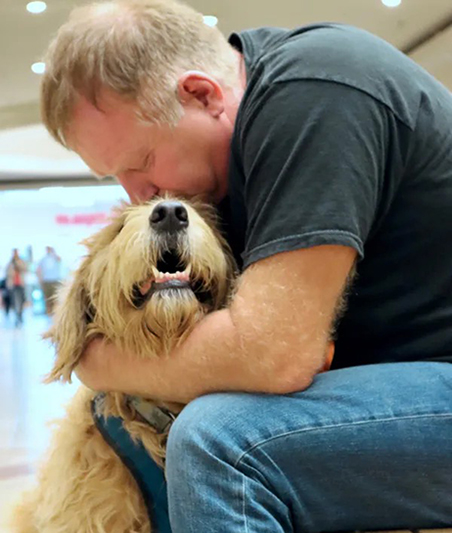
When people enter addiction treatment, health care providers often ask them about their family, their friends, and their support networks.
They rarely ask about their pets.
This points to a huge blind spot in our understanding of the important connection between humans and animals for health and wellbeing.
“Your relationship with an animal may be the strongest relationship in your life,” says Dr. Colleen Dell, Professor and Chair in One Health and Human-Animal Connections at the University of Saskatchewan.
Dr. Dell is on a mission to raise awareness about the importance of our connection to animals in healing. “I bring a dog everywhere I can,” she says. “If we’re talking about the dog, the dog is going to be there.”
Through her research, in part funded by CIHR, she has explored how therapy dogs can support people healing from substance use problems, individuals who are incarcerated, patients in hospitals, students in stressful school environments, and more.
“Animals can be incredibly important to our health and our healing,” she says, explaining that her research extends from therapy dogs and service dogs to companion animals like pet dogs and cats.
One area where Dr. Dell’s work has had significant impact is in addiction recovery. Her research has found that relationships with companion animals can support people recovering from substance use problems.
To help professionals in the substance use field recognize and build on these connections, Dr. Dell’s team launched an online course through the University of Saskatchewan. The course helps participants understand the benefits of the bond between humans and animals and learn how to incorporate animals into their practices in a way that best serves the animals and clients.
“Even if you ask your client simple things like: Do you have a pet? How important is that pet in your life?” says Dr. Dell. “Everybody needs to have this awareness.”
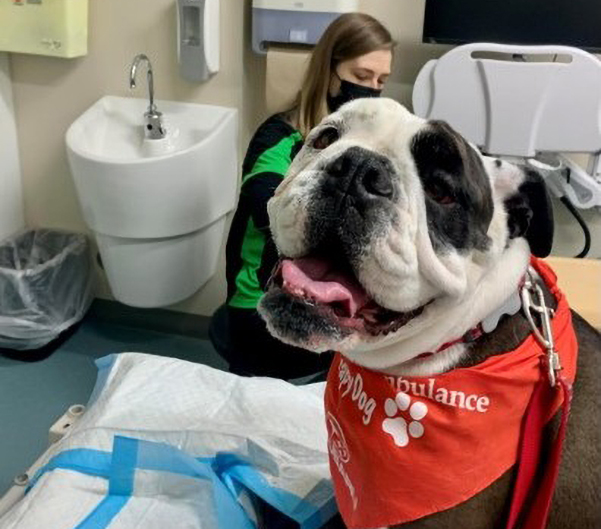
Her research has also opened doors in hospitals. In 2017, Dr. Dell’s team became the first in Canada to bring therapy dogs into the emergency department to spend time with people experiencing pain.
“Getting the dogs in there was not easy!” she recalls.
But their hard work was worth it. The therapy dog visits were shown to help reduce patients’ pain and anxiety. Now, Dr. Dell and her team work with other hospitals across Canada to help them integrate their own therapy dog programs.
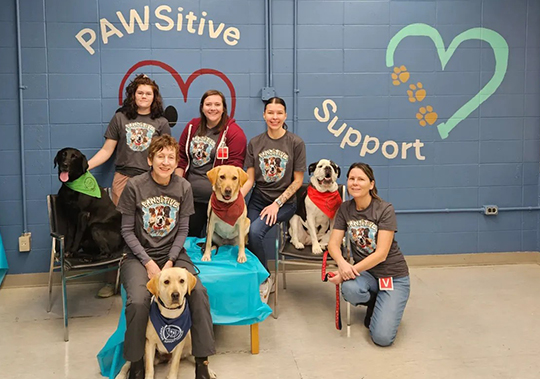
Dr. Dell also co-leads a first-of-its-kind program at Drumheller Institution in Alberta that connects people in prison with therapy dogs. “The therapy dogs give the participants their undivided attention,” says Dr. Dell. “The individuals at Drumheller often talk about not feeling like they are in prison in that moment.”
Participants from this program widely report feeling unconditional acceptance from the therapy dogs.
Looking ahead, Dr. Dell wants to see greater recognition for the role animals play in our wellbeing. She also emphasizes that these relationships are a two-way street.
“We can’t just look at them with a use value. They need to be on the other end of that relationship,” she points out.
“The more we see therapy dogs in the community and recognize them for what they’re doing, the better,” she says. “These are incredible animals giving such service to our community.”
At a glance
Issue
For many people, their relationship with an animal might be the most important connection in their life. Yet animals are rarely considered when it comes to health care or addiction treatment.
Research
Dr. Colleen Dell and her team are shining a light on the importance of our connection to animals in healing. Their research has shown that therapy dogs help reduce patients’ pain and anxiety, support recovery from substance use, and provide connection to people who are incarcerated.
- Date modified: