Reimagining Acute Care Initiative: Components
Areas of focus
The Reimagining Acute Care Initiative focuses on improving the integration of the three phases of the care continuum.
- Pre-acute: Prevent hospitalization for at-risk patients
- Acute care: Improve outcomes from medical and interventional procedures
- Post-acute: Enhance sustainable and effective health recovery
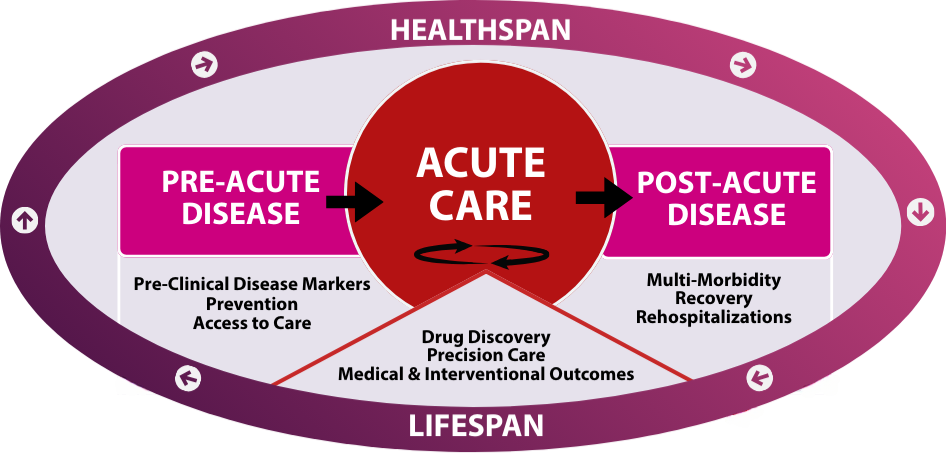
Long description
The graphic is structured around three main stages of disease and care:
- Pre-Acute Disease
- Pre-Clinical Disease Markers
- Prevention
- Access to care
- Acute Care
- Drug Discovery
- Precision Care
- Medical & Interventional Outcomes
- Post-Acute Disease
- Multi-Morbidity
- Recovery
- Rehospitalizations
These stages are arranged within an oval frame, with "Healthspan" labeled at the top and "Lifespan" at the bottom, suggesting a continuum of health across a person's life.
Each stage is enclosed in a separate box: Pre-Acute Disease on the left, Acute Care in the center and Post-Acute Disease on the right.
The Acute care section is highlighted with a large red circle at the centre of the oval. Beneath this circle is a triangle, symbolizing balance between the surrounding stages with a circular arrow, representing the recurring and dynamic nature of acute medical interventions.
A single directional arrow flows from the pre-acute box into the central Acute care circle, followed by another arrow extending from the Acute care circle into the post-acute box, illustrating the continuum of care from early intervention through acute treatment to recovery.
Cross-Cutting Components
To amplify the impact of this initiative, several cross‑cutting components will guide how funding opportunities and research activities are designed, conducted, and applied. These components encourage collaboration, innovation and inclusive research practices, to ensure that work across the phases of the care continuum is comprehensive, forward‑looking and responsive to clinical needs.
- Multi-research-area integration
Research that integrates multiple research fields through four research pillars and three phases of the care continuum to address the complexity of health conditions within ICRH’s mandate and beyond. - Data and digital innovation
Harnessing data science, artificial intelligence, digital health infrastructure and real‑world data in new and innovative ways to strengthen analysis, prediction and system planning, while promoting open science, interoperability and responsible data sharing and sovereignty. - Interdisciplinary and multisector collaboration
Collaboration across expertise, sectors, disciplines, and organizations to accelerate progress from research to real-word implementation, ensuring innovations are scalable, impactful, and responsive to the needs of people and communities. - Equity, diversity and inclusion
Approaches that address inequities in care access, outcomes and experiences, ensuring inclusive research practices and meaningful engagement of diverse populations and perspectives. - Capacity building
Training, mentorship and career development opportunities for trainees and researchers, alongside tools, platforms and infrastructure that strengthen long‑term research capacity across the care continuum. - Indigenous Research
Meaningful engagement with Indigenous communities to co-develop initiatives that respect their sovereignty and respond to health challenges relevant to Indigenous communities.
- Date modified: