From the ground up: Discovering solutions to antimicrobial resistance
One researcher's lifelong quest to stay ahead of superbugs is protecting health care as we know it.
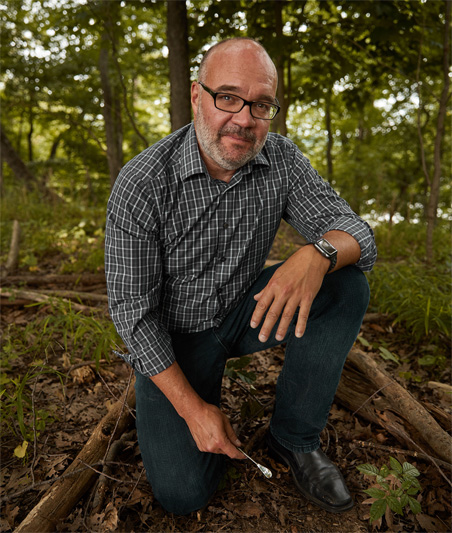
"If you want to defeat your enemy, you need to know your enemy."
That's not the answer people expect when they ask Dr. Gerry Wright what he does for a living. The McMaster University professor isn't talking about war. He's talking about bacteria.
For more than three decades, Dr. Wright has been studying bacteria's ability to outsmart the drugs designed to kill them, known as antimicrobial resistance (AMR). It's a problem that threatens one of humanity's greatest medical achievements: antibiotics.
"Antibiotics changed how we live and how we die," he explains. Before antibiotics, infections that seem routine today could be deadly. A cut on the hand, pneumonia, childbirth complications, or even minor surgery could become life-threatening. Modern medicine—from cancer treatment and organ transplants to intensive care and neonatal medicine—depends on effective antibiotics. However, their effectiveness is slipping away. As bacteria evolve resistance to existing treatments, the world faces a growing challenge that the World Health Organization (WHO) has identified as one of the most significant threats to global health. Understanding that challenge has become Wright's life's work.
While studying antibiotic resistance during a postdoctoral fellowship at Harvard Medical School, he saw firsthand how resistant infections were affecting patients. Rather than focusing solely on finding new drugs, Wright wanted to understand resistance itself: where does it come from, and how can scientists stay ahead of it?
In 2007, those questions ultimately led to one of his most influential contributions to modern medicine by establishing the concept of the "antibiotic resistome." Coined by Wright's laboratory, the term describes the vast collection of antibiotic resistance genes that exist throughout the microbial world, not just in human pathogens. The concept helped broaden scientific understanding of resistance by placing it within a much larger ecological context.
Wright applied that wider lens beyond the laboratory, playing a central role in establishing research centers, institutes, and collaborations focused on infectious diseases and antimicrobial resistance. His work helped establish McMaster University's M.G. DeGroote Institute for Infectious Disease Research and Canada's Global Nexus for Pandemics and Biological Threats, creating spaces where scientists from different disciplines can tackle complex problems together.
"The problem is so big that one skill set can't solve it," he says. "It absolutely takes a village." Scientific breakthroughs may begin in individual laboratories, but confronting antimicrobial resistance requires coordinated effort across institutions, sectors, and generations of researchers.
Recent discoveries from Wright's team, including promising new antibiotic candidates, have attracted international attention. Yet he remains realistic about what those discoveries represent. "The distance between the lab and the bedside is sometimes longer than we want," he says. "But we're always looking to do something that will have, at some point, a direct application."
Today, one of his goals is to help move some of those discoveries closer to patients, including exploring ways to advance new antibiotic candidates through biotechnology and commercialization pathways.
Despite decades of achievements, what excites Wright most remains the possibility of discovery itself. When most people look at a handful of soil, they see dirt. Wright sees billions of microbes producing chemicals that humans have barely begun to understand. "The smell of earth," he explains, "comes from the bacteria that live in the soil." Those same microbes have already yielded some of humanity's most important medicines, from antibiotics to anti-cancer drugs. To Wright, the ground beneath our feet is still a vast reservoir of untapped potential. "It's just an unbelievable opportunity," he says. "I just find endless possibilities."
Supported by decades of investment from the Canadian Institutes of Health Research (CIHR), Wright's work has helped reshape scientific understanding of antimicrobial resistance while strengthening Canada's capacity to respond to one of the defining health challenges of our time.
He shaped the field through the discoveries made in his laboratory, the scientists he trained, the organizations he helped build, and the growing recognition of antimicrobial resistance as not merely a hospital problem, but an ecological and global one.
Protecting antibiotics is about far more than preserving a drug. It's about protecting all aspects of health care. More than three decades after first encountering antibiotic resistance as a young researcher, Wright remains driven by the same challenge that captured his attention at Harvard: how do we stay one step ahead?
At a glance
Issue
Antimicrobial resistance (AMR) reduces the effectiveness of antibiotics, threatening modern health care, and making once-treatable infections increasingly dangerous. The World Health Organization recognizes AMR as one of the most significant global health threats, with impacts on everything from routine surgeries to cancer treatment.
Research
For more than 30 years, Dr. Gerry Wright has studied how bacteria develop resistance to antibiotics and how scientists can stay ahead of these evolving threats. His pioneering work introduced the concept of the antibiotic resistome, transforming understanding of resistance and helping guide the search for new treatments and collaborative solutions.
- Date modified: