A calculated risk: The search for a hepatitis C vaccine
With no vaccine and millions affected worldwide, CIHR-funded researchers are turning to a carefully controlled human infection model to accelerate hepatitis C vaccine development.
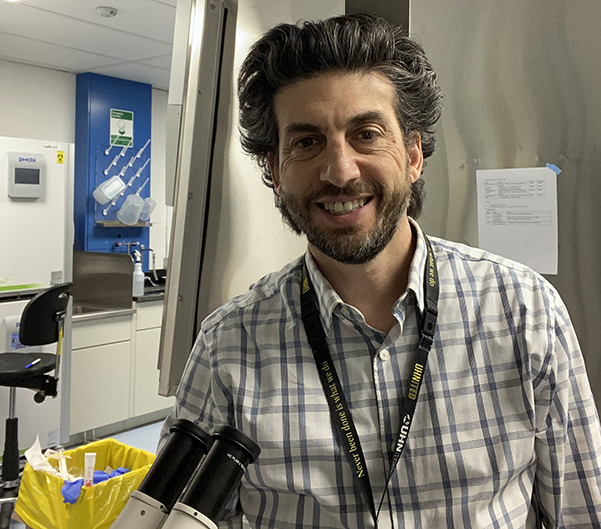
Would you volunteer to be intentionally exposed to hepatitis C, a virus that can cause serious liver disease, to help test a new vaccine?
Dr. Jordan Feld, a hepatologist and CIHR-funded senior scientist at UHN, is recruiting 100 healthy people under the age of 40 for a Controlled Human Infection Model (CHIM), or human challenge study. Participants will receive an experimental vaccine and then be intentionally exposed to hepatitis C under careful medical supervision. If the vaccine works, Canada could lead the efforts to eliminate hepatitis C globally, something that has proven challenging with treatment alone.
“We have very effective treatment for hepatitis C and can cure almost everybody we diagnose,” says Dr. Feld, “but we don't have a vaccine yet. Sadly, particularly driven by the opioid epidemic, we're seeing more people infected every year than we are curing.”
There are about 250,000 people in Canada living with the liver disease, and close to 40% of them don’t even know they have it. That is why hepatitis C is known as the “silent killer”. Left untreated, the infection can lead to cirrhosis, liver failure, or liver cancer.
Despite the severity of the infection, developing a vaccine against hepatitis C has proven difficult. There are two major obstacles. First, hepatitis C is highly genetically diverse, even more so than many other viruses. It constantly mutates and produces new variants, so a vaccine must protect against a wide range of strains, explains Dr. Feld. Second, testing such a vaccine is also challenging. Researchers typically rely on animal models, but with a ban on chimpanzee testing and no other available animal models, human trials are necessary.
Human infection models are not new. They have been used for tuberculosis, dengue and malaria; and the cholera vaccine Vaxchora was tested and approved in Canada and the United States using only human challenge studies. Hepatitis C is different, however. Because about 25% of people clear the virus naturally, volunteers must remain infected for a longer period to determine whether a vaccine truly protects against persistent infection. Those who clear it on their own do not develop liver damage… but researchers need sufficient time to measure vaccine effectiveness.
“What we're trying to do with a vaccine is essentially flip those odds,” explains Dr. Feld. “We want to boost that spontaneous clearance rate so that 75% of vaccinated people can fight off the virus naturally. If we can reach a point where only a small minority develop a chronic infection and we can treat them, then we could potentially eliminate hepatitis C globally.”
The research team is in the second year of the study and plans to infect volunteers in late 2026.
Dr. Feld noted that the participants tend to be young and highly educated. “They tell me they’re not scientists or physicians or engineers so they can’t directly develop a vaccine,” he says. “But they can volunteer their time and take some risk to contribute to science and society.”
“It’s amazing to hear their perspective,” he adds, recalling one volunteer who put it this way: “We don’t tell people they can’t be firefighters and run into burning buildings just because it’s dangerous. We thank them for doing it.”
Because the CHIM trial involves a relatively small number of closely monitored participants and uses a known viral strain, researchers can closely track how the immune system responds. This makes the human challenge study not only a model for testing a potential hepatitis C vaccine, but also a way to inform the development of vaccines for highly diverse pathogens like HIV and influenza, and even cancer.
“I know that we are going to learn so much from the process,” says Dr. Feld. “Even if the first vaccines don’t work, the knowledge we gain will move this field and other areas of science forward. If it is possible with current technology and ingenuity to make a hepatitis C vaccine, the CHIM is the pathway that will get us there.”
At a glance
Issue
Since 2017, hepatitis B and C have caused more deaths globally than HIV, tuberculosis, or malaria. Hepatitis C alone infects an estimated 50 million people worldwide causing hundreds of thousands of deaths each year. Unlike hepatitis B, however, there is still no vaccine for hepatitis C.
Research
Dr. Jordan Feld, clinician-scientist at the Toronto Centre for Liver Disease at Toronto General Hospital, University Health Network, is using a human infection model to study how the immune system controls hepatitis C virus infection in the liver. Traditional field trials for this infection are slow and impractical, so this study approach could accelerate vaccine development and provide insights for other problematic viruses.
- Date modified: